So many stories never make it to the screen. Lost in Transmission aims to change that by backing community storytellers & emerging creators with stories that often stay quiet, unnoticed, or unspoken.
Function8 supports and funds films and documentaries that blend creative and factual approaches to capture moments of resilience, identity, and collective life in Singapore.
Theme: Technology Meets Life
Under this year’s theme of “Technology Meets Life”, we’re seeking films that explore the unspoken side of the digital age. We are looking for creative factual stories that dig deeper and reveal how technology transforms our relationships, communities, and survival. Can technology help bring about a more just & equal world?
Grant Details
SG$2,500 per film (up to 2 projects will be selected)
Mentorship from Singapore filmmaking professionals like Tan Pin Pin, Yusri “Shaggy” Sapari.
Film will be premiered at FreedomFilmFest Singapore 2026
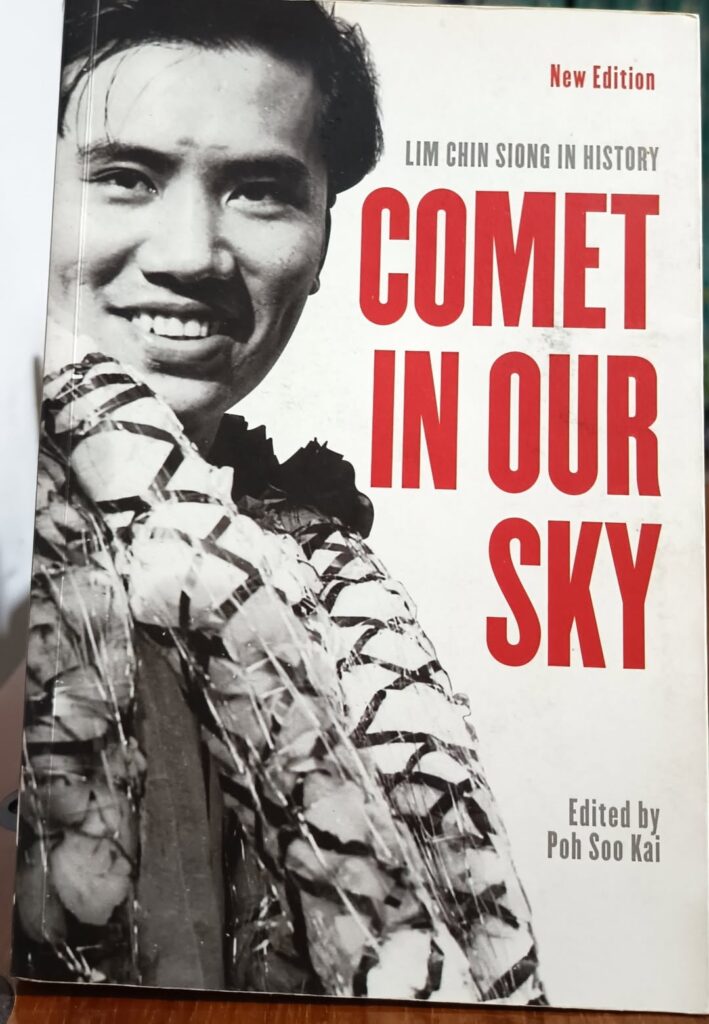
(In the process of decluttering, Teo Soh Lung found the text of a speech she delivered at the launch of the new edition of Comet in Our Sky on 9 August 2015. Below is her speech.)
***
When the first edition of Comet in Our Sky was launched in Kuala Lumpur in 2001, I did not attend because I was not aware of it. I only came to know about the book when Tan Jing Quee (its editor) asked me to help him sell some copies. And that was the first time that I read about Lim Chin Siong.
Let me tell you how important that book was to me then and now.
I was educated in an English school, a Catholic school. Even though my school was located along Middle Road, I knew nothing about the activities that went on at the trade union along the same road. I lived in another world.
I remember when I was in school, buses occasionally did not run because the drivers had gone on strike. I was very happy when that happened because it gave me the opportunity to walk home with my brother and sister, stopping by the Singapore River to watch the boats! I didn’t know the planning of the strikes originated in Middle Road.
My father managed a photo studio not too far from Middle Road. He was effectively trilingual and I used to see the Chinese daily on the table in the reception hall. Operation Coldstore took place when I was 14 years old but I have no recollection of the horrendous incident in history. My father would have read about that incident but he said nothing at home. He and my eldest brother who helped him in the studio probably thought that it was best to remain neutral. I am quite sure they were aware of the arrests in 1963 and even those in the 1950s because their studio specialized in portraiture and was popular with university graduates who took their graduation photographs there. I have seen advertisements in the students’ publication Fajar.
Looking back, I think my father didn’t want any of his English educated children to be involved in politics because he probably knew that politics was dangerous especially when you are on the opposite side of the PAP! He rather preferred to be neutral and minded his own business, taking photographs of Lee Kuan Yew, David Marshall, Dr Lee Siew Choh and British officials like Sir William Goode, the attorney general and several colonial judges.
I had the good fortune of meeting Lim Chin Siong in the early 1980s when I think he was then working with his brother and Jing Quee in nearby Colombo Court. It was my misfortune that I didn’t know Singapore history then and hence missed the opportunity of conversing intelligently with the great man.
So you see, unlike Chinese educated students of my time, I lived in total ignorance. And so it was absolutely important that decades after the incident, Tan Jing Quee and K S Jomo published Comet in Our Sky in 2001. It was the first time I learned about the intrigues and cruelty of politics and the dishonesty of the British.
Re reading the chapters in the book today depresses me. I don’t remember feeling depressed when I read the first edition of Comet in Our Sky. But now, re reading it depresses me and I had to read the chapters with many breaks. I am no longer able to remain detached and uninvolved like historians digging out the past or lawyers fighting the causes of their clients because I have come to know many of the survivors of Operation Coldstore who have spent decades in prison. What they and their families went through was uninmaginable. I only wish that the younger PAP leaders would read more books like Comet so that they too will learn about the ugly side of PAP’s history and reflect on the evil deeds of Lee Kuan Yew and his colleagues.
To know the life of Lim Chin Siong, and here I am very grateful that Jing Quee has written such an eloquent piece about him in the book and M K Rajakumar had given us a more detached description of Lim and analysed his strength and weaknesses, comparing him with the savvy Lee Kuan Yew who was networking with people in high places, is not only to know his humility, oratorical skill, greatness and courage but also the depth of depravity of Lee Kuan Yew. For his personal glory and power, Lee was prepared to carry out grave injustices to his comrade and his family and colleagues. Lee was a bully, taking advantage of Lim Chin Siong who was ten years younger than him. I cannot fathom the cruelty of the man when he acted as Lim’s lawyer during his imprisonment for the purpose of betraying him. Lim said in his manuscript which is translated by his brother, Chin Joo that he was kept isolated from the rest and was not informed of what happened outside. Jing Quee told me that he was kept in the refractory block, close to the death row prisoners.
Before the publication of Comet in Our Sky in 2001, there was a coffee table book published by Melanie Chew in 1996 which contains an interview with Lim Chin Siong. But that book cost $200 and few could afford it.
It took 38 years after Coldstore for Comet in Our Sky to be published and to be launched in KL and quietly sold in Singapore. It tells a great deal. We can say that it was fear that prevented the left from writing about the past. But I’d like to say that it speaks a lot about the courage and foresight of Jing Quee and Jomo to bring this book to light.
It is important for young Singaporeans to read this book and to understand why Singapore is what she is today. We were once a vibrant society until Lee Kuan Yew came to power and destroyed everything that was anathema to him.
We are very fortunate that Dr Poh Soo Kai has finally edited and published this new edition after a decade of it running out of print. Dr Poh works very hard. At the age of 84, he should be relaxing. Instead, he is working harder than a man half his age. Maybe this is to compensate for the loss of 17 long years in prison!
We applaud his determination and stamina to show up the government that it has not been telling the truth because they just want to be in power. “Truth”, Dr Poh said to the BBC recently “is on his side and he must explain that for future generations and for history.” We salute Dr Poh.
Comet in Our Sky (new edition) is available at all good bookstores e.g City Book Room and as an ebook from Amazon, Kobo, National Library, and other online outlets.
Function8 would like to thank the publisher and editors of Living with Myths in Singapore for granting us the permission to share with you Soh Lung’s contribution.
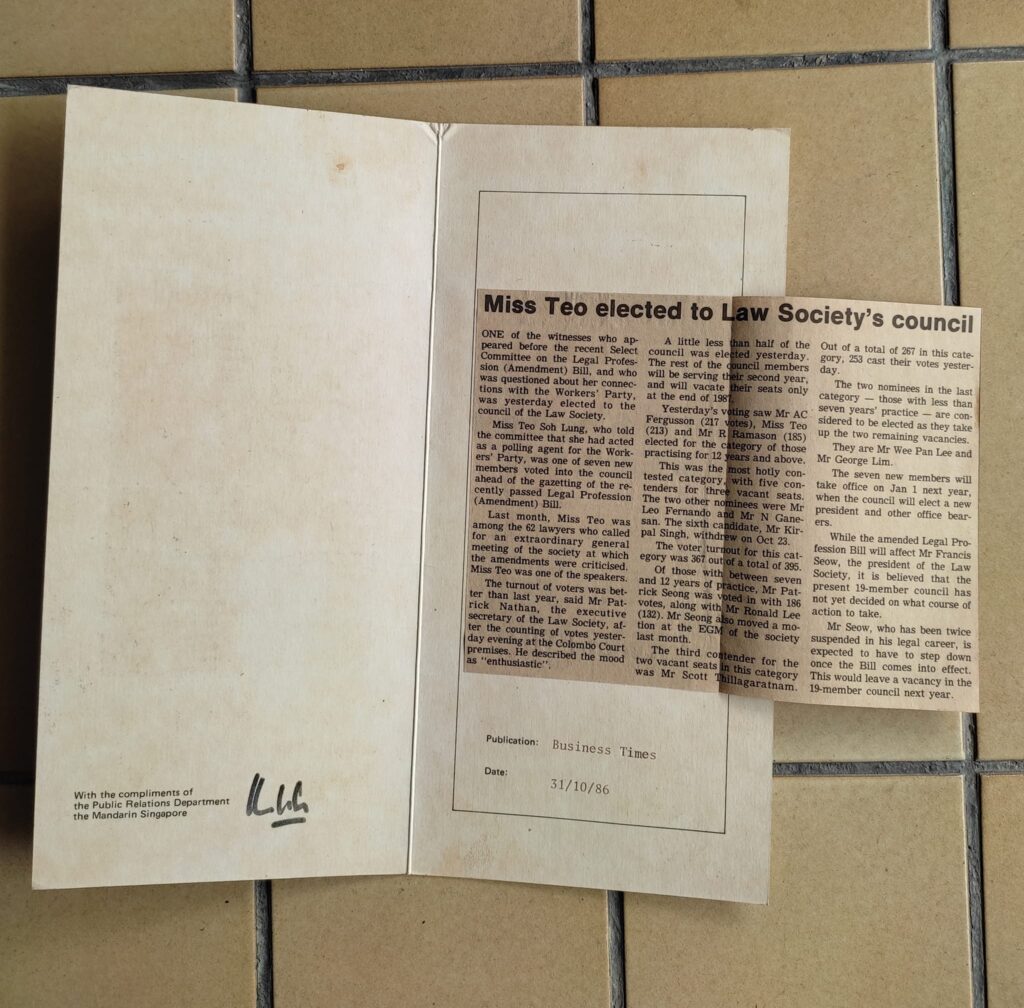
Reading this news cutting of 31 October 1986 today, and knowing the history of Singapore and the PAP better than nearly 40 years ago, I can say that the PAP’s method of control has not changed. Its attitude towards those who disagree with them is simply “FINISH THEM OFF”.
Our first prime minister, Lee Kuan Yew was a lawyer. E.W. Barker was his law minister. He was also a lawyer. Between the two of them, it was easy to use laws to wipe out any opponent. Anyone who poses a potential threat to the survival of the PAP would be “nipped in the bud”. If they can be won over, invite them to join the party. If not, just finish them off. Use any legal means to do that. It does not matter because everything is as Dr Lim Hock Siew who was detained for 20 years without trial puts it, “Everything is by the law”. They make the laws and everything they do is legal.
The first two paragraphs of the news cutting are interesting. I recall that I was asked at the select committee hearing about my involvement with the Workers’ Party. I was not a party member but I did help the party during one election. A fellow lawyer, Mr M.P.D. Nair asked me to be his polling agent. I agreed. As everyone knows, it wasn’t a big thing to be a polling agent. Indeed it was a citizen’s duty to be a polling agent. But at the select committee hearing, the home affairs minister, Mr S. Jayakumar made it sound like it was illegal to be one. I was surprised and wondered what he was up to. If he thought I would deny helping the WP, he was sadly mistaken. I admitted. He persisted in asking some silly questions. On seeing that he was getting no where with my honest answers, Lee Kuan Yew dramatically snatched his papers and took over the cross examination.
The third paragraph reminded me that the Law Society conducted an extraordinary meeting at the request of 62 members who sought the withdrawal of the Amendment to the Legal Profession Bill. The minimum number of members who wished to call a meeting at that time was 25. So 62 members was a very credible number. I think members were all unhappy with the bill which primarily sought the removal of Mr Francis Seow as its president.
Seow was elected as the president by members of the Council of the Law Society in late 1985. It was none of the business of Lee or his ministers to interfere in the leadership of the society. Between Lee and Barker however, they must have scoured through Seow’s personal history. They managed to dig out some old offence which took place decades ago. They made them disqualifying conditions for anyone to hold the office of president of the Law Society. It was most deplorable. Lee and Barker enacted the new law to take retrospective effect and thus to disqualify Seow as president.
The Law Society should have challenged the constitutionality of the law. I think they would have the entire backing of members back then. Sadly, the Council did not do anything. What was worse and utterly disgraceful was that its council did not hold any meeting to discuss the bill with members. Council members did not see it necessary to defend its president and the future of the Law Society!
And so it was left to ordinary members to defend its president and their Law Society. Sixty-two members called for the meeting. I was the proposer and Mr Patrick Seong was the seconder.
In later years, I discovered that the council did discuss the holding an extraordinary general meeting but the majority opposed the proposal. Perhaps members of the Council predicted that those who called the meeting would be arrested under the ISA!
Before 1986, members of the Law Society were generally not interested in standing for election to become members of its council. Council members were largely lawyers from big firms who were generally important to the government. The sudden interest of lawyers from small law firms standing for election to Council may have rung an alarm bell to Lee and Barker. They probably jumped to the conclusion that a “revolution” was on the way to turn the society into a socialist front! The old idea of communist united front must have terrified them.
While I can understand Lee and Barker’s fear of a “revolution,” I think it is most irresponsible of them to decimate decent citizens who want the best for their society and their country. A responsible government will listen to the people. If they cannot find solutions to the issues raised by the people, they should be voted out. Endless tweaking of laws to ensure that the party survives at all costs by decimating any form of competition from dissidents is most unhealthy for the survival of Singapore.
But throughout the history of the PAP, the only means to ensure survival is the crushing of dissent by laws. They have done that since independence in 1965. The “offences” they legislate have become more and more petty. Indeed, they have become ridiculous. How can it be an offence for one person to hold an A4 size sheet of paper with a smiley face be an offence?
The PAP have succeeded in retaining power for six decades at the cost of sacrificing the people of Singapore. Will it lose power one day?
Function 8 ended 2025 the Singaporean way! Meeting old friends and supporters too busy with work, family and activities during normal times. We chatted, joked, ate and sang songs, sentimental and activist songs and songs that even reminded several former ISA prisoners of prison days. Donna Donna, a song about a poor calf bound for slaughter reminded one of them about those unjust days that made singers of all those locked up within grey concrete walls. Bad experiences never really go away. They are buried deep in the mind and emerge when least expected.
Donna Donna sung at the gathering
The gathering did not forget two of the many who are now in self exile, namely Roy Ngerng and Terry Xu. How can a government deprive citizens of their country when all they did was to disagree with its policies? How can it enact and implement draconian laws against opponents? Roy Ngerng had criticised the CPF scheme and Terry Xu had steadfastly given voice to the voiceless in his online journal The Online Citizen. So our singers sang All I Want For Christmas Is My CPF(the link is to an earlier version from our previous gathering at The Agora) for them.
Among the guests were survivors of Operation Coldstore. They sang I Love Malaya.
Will the young PAP leaders attempt to know their history, dedication and contribution towards the independence of Singapore? They have made Malaya their home in their youth and many had been detained without trial.
Returning to the present troubled side of Singapore, Iris Koh reminded us of M. Ravi whose courageous and controversial life had sparked expressions of both love and hate. She dedicated Joni Mitchell’s Both Sides Now to M. Ravi.
Life is already very difficult to live to the fullest. Why would a government which has the duty to ensure a better life for its citizens, bully them and demand conformity? Why crush their lives?
So while we enjoyed a great year end party, we are also reminded of the troubled times we face today and days gone.