Part 1 of 6: Post War and Fajar
Part 2 of 6: Merdeka Years
Part 3 of 6: PAP In Power
Part 4 of 6: Barisan Sosialis
Part 5 of 6: Operation Coldstore
Part 6 of 6: Last Years of Detention

Part 1 of 6: Post War and Fajar
Part 2 of 6: Merdeka Years
Part 3 of 6: PAP In Power
Part 4 of 6: Barisan Sosialis
Part 5 of 6: Operation Coldstore
Part 6 of 6: Last Years of Detention
by Teo Soh Lung
A government that holds 78 out of 79 seats in parliament can still be afraid of losing power. This is the sorry state of the PAP the 1980s and even today.
Perpetually afraid of more opposition members entering parliament, it adopted the policy of NIP IN THE BUD since the days of its founder, Lee Kuan Yew.
In 1987, the PAP took drastic measures to ensure that at least two Singaporeans living thousands of miles away from Singapore do not return to contest the general election which must be held before the end of 1988.
Holding super majority in parliament, it was easy for the PAP to amend laws and even the most sacred of laws, the Constitution of the Republic of Singapore. Thus in 1985, the PAP presented a bill to amend Article 135 of the Constitution. Any citizen (including a citizen by birth) who has not returned to Singapore for a continuous period of 10 years may be deprived of his Singapore citizenship.
Tan Wah Piow was one such citizen. He had proven himself to be a thorn in the flesh of the government when he was a young architecture student in the 1970s. They tried to get rid of him by fabricating a riot in the Pioneer Industries Employees’ Union in Jurong. He was charged for rioting and duly convicted by the First District Judge, Mr T S Sinnathuray. He served a jail term and left Singapore, escaping enlistment into the army. Since then he has been living as an exile in London.
In 1984 or 1985, Tan Wah Piow had intended to return home to Singapore. He was prepared to pay the usual fine and jail term for evading national service. He made enquiries from personnel who he thought could assist him. But before he could complete his preparations to return, the PAP government pre-empted him from returning. He received a notification that the government would deprive him of his citizenship because he had failed to return home for 10 years.
Tan Wah Piow appointed me as his lawyer He instructed me to oppose the decision of the government. How could it deprive a citizen by birth of his citizenship? It was against international law! But even before I could take my client’s full instructions, I together with 15 others were arrested under the Internal Security Act on 21 May 1987. Tan Wah Piow was named the alleged leader of the “Marxist Conspirators”. His entire file was taken away when security officers raided my office.
Making sure that Tan Wah Piow would not be able to return to Singapore was not sufficient for a vindictive government. Even arresting another six innocent young people a month later, on 20 June 1987 was not enough. In July that year, the Controller of Immigration issued a notification to Paul Lim Huat Chye, a PhD student at the Catholic University of Louvain in Belgium, cancelling his Singapore passport with immediate effect. It promised to issue a document of identity to enable him to return if he was aggrieved by the decision. The letter read:
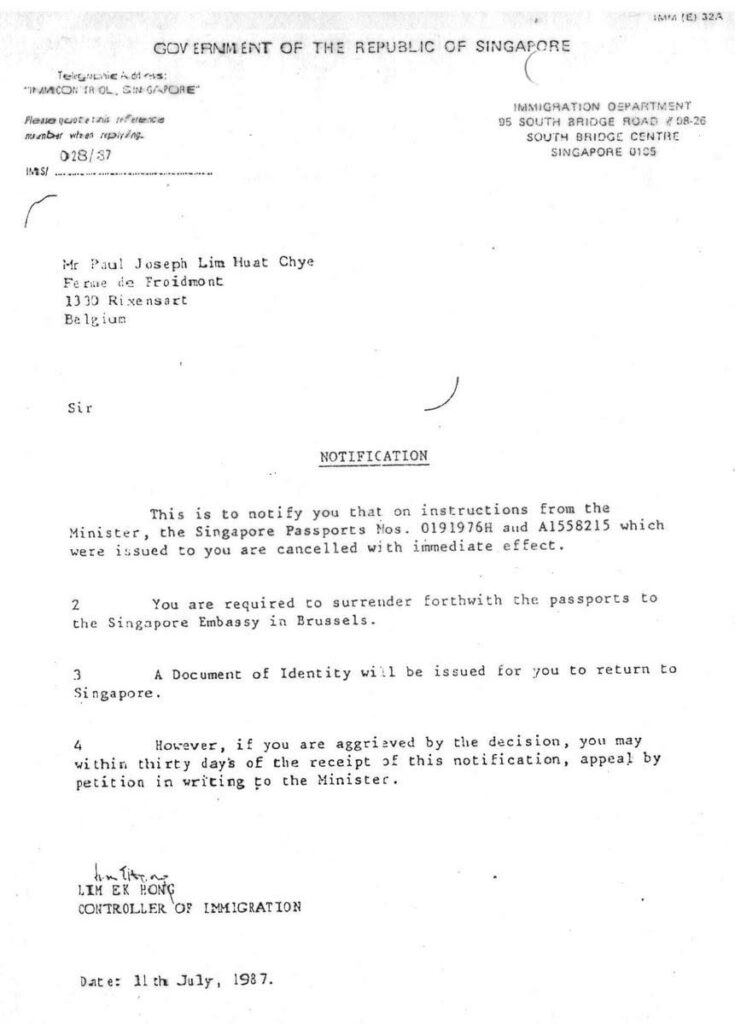
Sir
NOTIFICATION
This is to notify you that on instructions from the Minister, the Singapore Passport Nos. 0191976H and A1558215 which were issued to you are cancelled with immediate effect.
2 You are required to surrender forthwith the passports to the Singapore Embassy in Brussels.
3 A Document of Identity will be issued for you to return to Singapore.
4 However, if you are aggrieved by the decision, you may within thirty days of the receipt of this notification, appeal by petition in writing to the Minister.
SdLIM EK HONGCONTROLLER OF IMMIGRATION
Date: 11th July, 1987
It was an invitation to Paul Lim to deliver himself into the lion’s den and be eaten up like the 22 already in detained. Paul Lim asked for the government’s reasons for cancelling his passport. As expected, the government kept silent. A warrant of arrest was also issued against him. Paul was thus compelled to issue a press statement on 18 July 1987. It reads as follows:
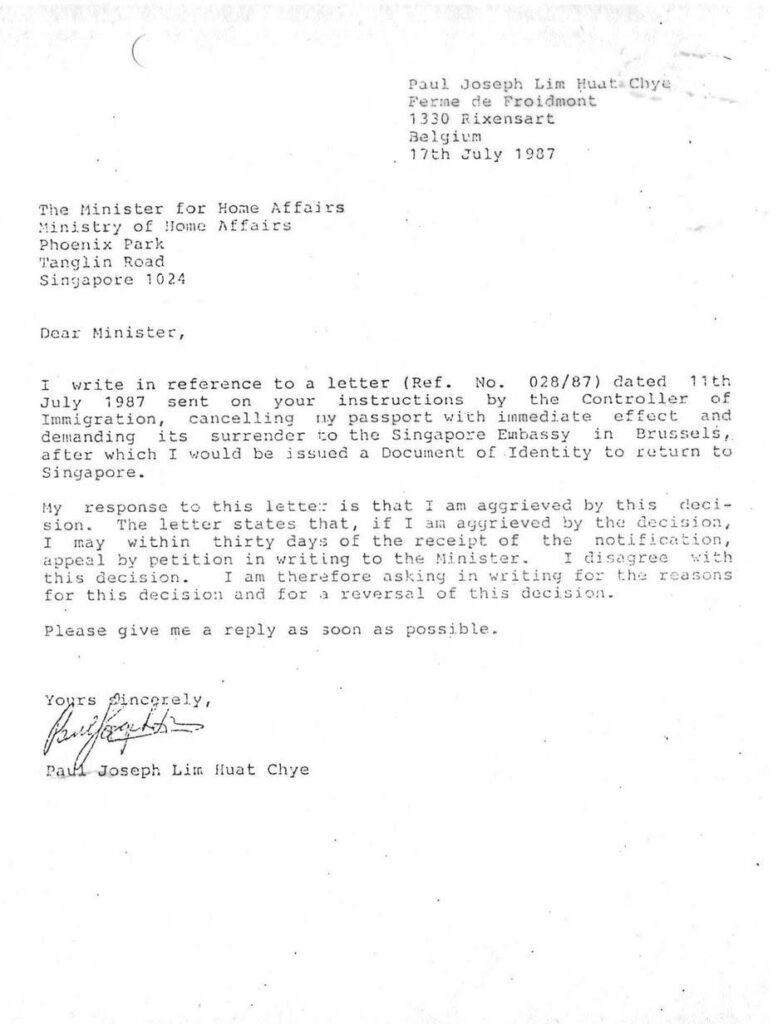
“Statement by Paul Lim concerning Minister’s decision to cancel his passport.
On 15th July 1987 I received by registered post a Notification (copy attached below) dated 11 July 1987 from the Singapore Embassy in Brussels in which I was informed that my Singapore passport was cancelled forthwith.
In my reply (copy attached below) I have asked for a written explanation of this decision. However, it is fair to suppose that this decision is connected with the fact that the Singapore government has issued an arrest warrant in my name under the Internal Security Act which permits detention without trial. This notification is clearly an attempt to compel me to return to Singapore and place myself in the hands of the Internal Security Department.
I ask again that I be removed from this wanted list. My political activities in Singapore have never in any way been illegal or illegitimate. If one removes the terms “Marxist conspiracy”, from the Singapore government’s accusations against me, I am only ‘accused of activities which are in reality – and under Singapore law – perfectly legal and acceptable. Talking politics to friends is legitimate and lawful. Describing my political activities and those of others as conspiratorial is no more than an unsubstantiated allegation. The only ‘evidence’ offered by the Singapore government is that provided by confessions of those recently detained – confessions obtained in conditions of “continuous interrogation under extreme psychological pressure” according to Amnesty International.
The PAP government has no right to cancel my passport for my legitimate and legal political activities. “Marxist conspiracy” and “Marxist conspirators” are simply pretexts to destroy nascent sources of a credible alternative opposition – something which the PAP itself claims to wish for.
SdPaul LimFerme de Froidmont1330 RixensartBelgique18th July 1987″
Despite what the PAP government did, Paul Lim continued to contribute to the well being of Singapore. He co-founded the European Institute of Asian Studies (EIAS) in 1989 (see https://eias.org/news/in-memoriam-paul-joseph-lim/ ) and entertained Singapore diplomats when they arrived in Brussels. But as Paul’s friend, I know that he was deeply hurt by what the Singapore government had done to him in 1987. He visited Singapore once at the invitation of a university or organisation and stayed with the Belgium ambassador who was also his guarantor. Thereafter, he never returned. He worked at his institute in Penang for several years. Friends would meet up with him when he was in the region.
He died in Belgium on 21 July 2025
by Teo Soh Lung
On 21 May 1987, sixteen people were arrested and detained under the ISA. Paul Lim Huat Chye who resides in Belgium was named by the Singapore government as part of the marxist conspiracy to overthrow the PAP government using violent means. It was an false and absurd allegation against an innocent man who at that time was trying to finish his PhD thesis at the Louvain Catholic University. That allegation not only interrupted the completion of his thesis, it also led him to lose his Singapore citizenship.
Below is Paul Lim’s refutation of the Singapore government’s false allegation against him:
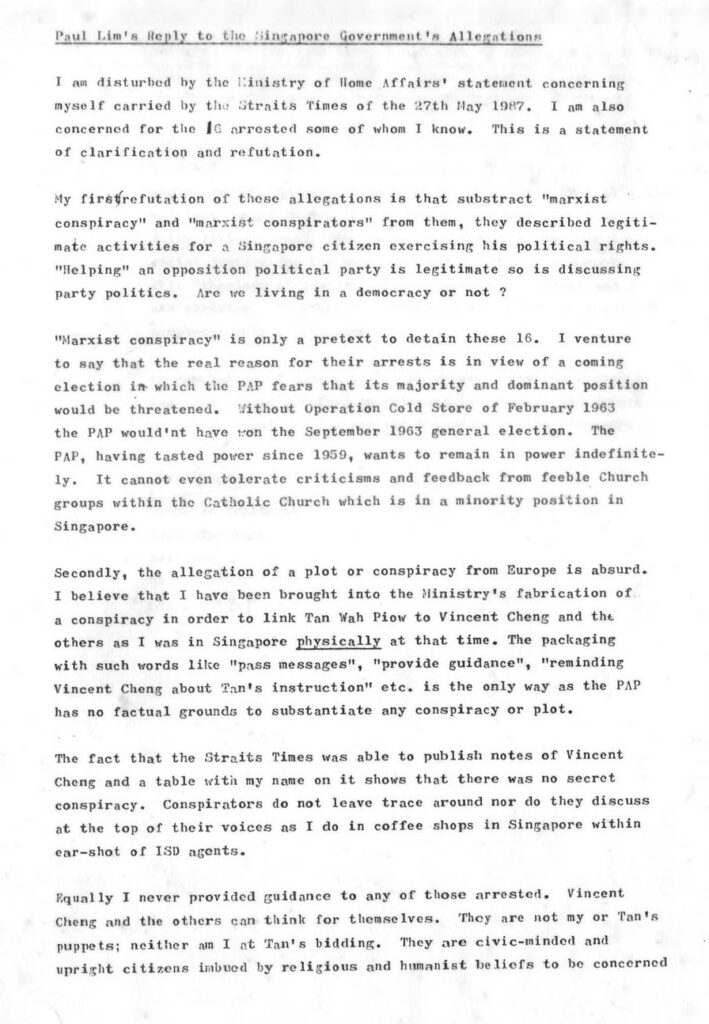
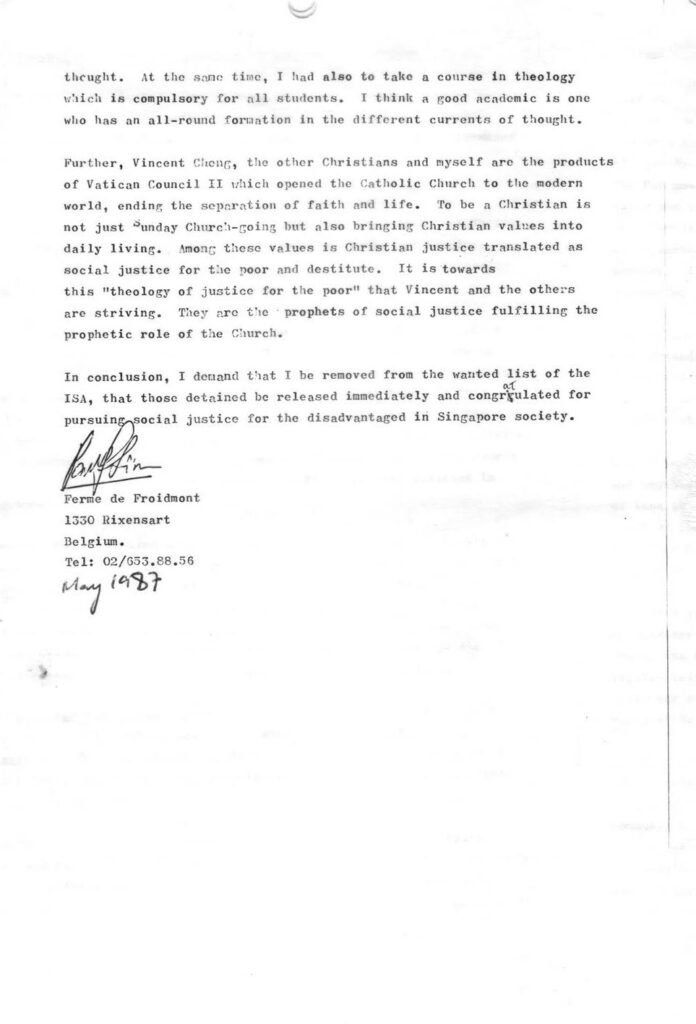
Paul Lim’s Reply to the Singapore government’s Allegations
I am disturbed by the Ministry of Home Affairs’ statement concerning myself carried by the Straits Times of the 27th May 1987. I am also concerned for the 16 arrested some of whom I know. This is a statement of clarification and refutation.
My first refutation of these allegations is that subtract “marxist conspiracy” and “marxist conspirators” from them, they described legitimate activities for a Singapore citizen exercising his political rights. “Helping” an opposition political party is legitimate, so is discussing party politics. Are we living in a democracy or not?
“Marxist conspiracy” is only a pretext to detain these 16. I venture to say that the real reason for their arrests is in view of a coming election in which the PAP fears that its majority and dominant position would be threatened. Without Operation Cold Store of February 1963 the PAP would’nt have won the September 1963 general election. The PAP, having tasted power since 1959, wants to remain in power indefinitely. It cannot even tolerate criticisms and feedback from feeble Church groups within the Catholic Church which is in a minority position in Singapore.
Secondly, the allegation of a plot or conspiracy from Europe is absurd. I believe that I have been brought into the Ministry’s fabrication of a conspiracy in order to link Tan Wah Piow to Vincent Cheng and the others as I was in Singapore physically at that time. The packaging with such words like “pass messages”, “Provide guidance”, “reminding Vincent Cheng about Tan’s instruction” etc is the only way as the PAP has no factual grounds to substantiate any conspiracy or plot.
The fact that the Straits Times was able to publish notes of Vincent Cheng and a table with my name on it shows that there was no secret conspiracy. Conspirators do not leave trace around nor do they discuss at the top of their voices as I do in coffee shops in Singapore within ear-shot of ISD agents.
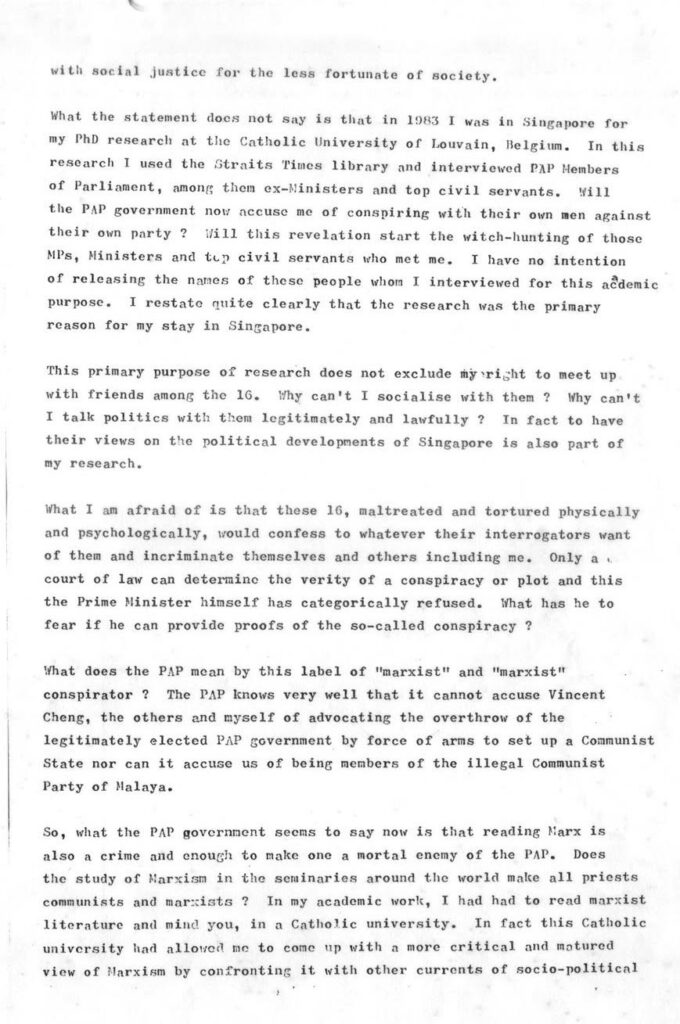
Finally I never provided guidance to any of those arrested. Vincent Cheng and the others can think for themselves. They are not my or Tan’s puppets: neither am I at Tan’s bidding. They are civic-minded and upright citizens imbued by religious and humanist beliefs to be concerned with social justice for the less fortunate of society.
What the statement does not say is that in 1983 I was in Singapore for my PhD research at the Catholic University of Louvain, Belgium. In this research I used the Straits Times library and interviewed PAP Members of Parliament, among them ex-Ministers and top civil servants. Will the PAP government now accuse me of conspiring with their own men against their own party? Will this revelation start the witch-hunting of those MPs, Ministers and top civil servants who met me? I have no intention of releasing the names of those people whom I interviewed for this academic purpose. I restate quite clearly that the research was the primary reason for my stay in Singapore.
This primary purpose of research does not exclude my right to meet up with friends among the 16. Why can’t I socialise with them? Why can’t I talk politics with them legitimately and lawfully? In fact to have their views on the political developments of Singapore is also part of my research.
What I am afraid of is that these 16, maltreated and tortured physically and psychologically, would confess to whatever their interrogators want of them and incriminate themselves and others including me. Only a court of law can determine the verity of a conspiracy or plot and this the Prime Minister himself has categorically refused. What has he to fear if he can provide proofs of the so-called conspiracy?
What does the PAP mean by this label of “Marxist” and “Marxist conspirator? The PAP knows very well that it cannot accuse Vincent Cheng, the others and myself of advocating the overthrow of the legitimately elected PAP government by force of arms to set up a Communist State nor can it accuse me of being members of the illegal Communist Party of Malaya.
So, what the PAP seems to say now is that reading Marx is also a crime and enough to make one a mortal enemy of the PAP. Does the study of Marxism in the seminaries around the world make all priests communists and Marxists? In my academic work, I had had to read Marxist literature and mind you, in a Catholic university. In fact this Catholic university had allowed me to come up with a more critical and matured view of Marxism by confronting it with other currents of socio-political thought. At the same time, I had also to take a course in theology which is compulsory for all students. I think a good academic is one who has all -round formation in different currents of thought.
Further, Vincent Cheng, the other Christians and myself are the products of Vatican II which opened the Catholic Church to the modern world, ending the separation of faith and life. To be a Christian is not just Sunday Church going but also bringing Christian values into daily living. Among these values is Christian justice translated as social justice for the poor and destitute. It is towards this “theology of justice for the poor” that Vincent and the others are striving. They are the prophets of social justice fulfilling the prophetic role of the Church.
In conclusion, I demand that I be removed from the wanted list of the ISA, that those detained be released immediately and congratulated for pursuing social justice for the disadvantaged in Singapore society.
SignedPaul LimFerme de Froidmont1330 Rixensart
by Teo Soh Lung (first published on F8 Facebook on 17th Jun 2024)
I thank Minister Shanmugam for his response to my post.
I am happy to apologise that I had wrongly assumed that he was in Singapore when the students presented their letters. Would he, when he is home, meet them?
I concede that as a minister, Mr Shanmugam has met more young people than me. But I think he has missed a group of young people who are deeply passionate about their cause/s and are prepared to break the law as the minister puts it.
But is “law-breaking” always wrong? This is where he and I do not agree.
In 1803, Prudence Crandall broke the Black Law when she admitted a African-American girl to her school. She was arrested and spent a night in jail. Rather than continue with Connecticut’s racial discrimination laws, she decided that if white girls won’t attend her school with black girls, she would educate black girls. Repeated trials for breaching the law as well as backlash from the community made it unsafe for her to manage her school. Ultimately, she was forced to leave the state. Years later she was honoured as Connecticut’s State Heroine.
It took more than 200 years and thousands of people jailed before discriminatory laws were slowly repealed.
In India, Mahatma Gandhi, at the age of 61, broke the British salt laws because he didn’t agree that tax should be levied on such an essential item that affects the poor. He led a 385km march from his ashram to Dandi. Thousands joined him. It took them 24 days. At Dandi, he contravened the law by making his own salt. In the next two months, his followers continued to break the law. Nearly 60,000 people, including Gandhi himself were arrested.
Today, Gandhi is respected by every activist for his non-violent resistance which helped end British rule in India.
I fully understand the minister’s preference for orderly communications and dialogues behind closed doors. Write to REACH is one way to give feedback. I have tried writing to REACH as well ministers. But I don’t even get an acknowledgement! If all his methods work and changes suggested by citizens are implemented, I think there would not be any attempt to publicise a cause by breaking the law. The problem is that these orderly processes don’t work. Many are disheartened and stop being civic-minded. It is Singapore’s loss that youthful idealism is killed before it can even flower. But for the government, it may be considered timely intervention.
Minister Shanmugam said that my advice to let the young people break the law “will inevitably lead to protests of a much more violent and intemperate nature that we see in some other countries”. I don’t know how he arrived at that conclusion.
I don’t agree that walking to the Ministry of Home Affairs procession-like will cause chaos and disorder. In fact, the students dispersed peacefully after two of their representatives delivered their letters. What is there to investigate? Why waste the time of the police in having to interview 30 or 40 students? Incidentally, my comment on the students is not restricted to them. If 1000 old or middle-aged people peacefully delivered 100 letters to his ministry, I would still maintain that the police should not take any action.
Violence is not an inevitable consequence of a protest. Peaceful, non-violent protests are the norms today. If any protest turns violent, it is usually sparked by outsiders or enforcement agencies. So I urge the minister to be more relax and have confidence in the people. We too love Singapore and will not turn it into a burning city.
Minister Shanmugam accused me and a few others of repeating “old tired tropes”. I don’t think this is fair. Activists know that change cannot be achieved in a day. It is thus necessary to repeat old tropes as the government too keeps repeating its old tropes that it does listen to the people!
Over the decades, many laws and amendments to existing laws which curtailed freedom of speech and expression have been passed. The one-person unlawful assembly or procession law is extremely oppressive. I have been consistent in criticising this law ever since its enactment and each time some young people get arrested and jailed. It is an old trope but this ridiculous law remains on our statute books. So how can I not repeat old tropes!
Today, we have many laws that authorise the executive to make orders restricting the rights of individuals. POFMA for example permits the ministers or their subordinates to issue correction notices. The Maintenance of Religious Harmony Act also allows ministers to issue restraining orders. This is wrong. Judicial powers should rest with our judiciary. Our Constitution guarantees separation of powers. While it is convenient for ministers to issue orders and notices, it erodes the power of our courts.
When Singapore achieved independence, oppressive colonial laws should have been repealed. Instead, new laws which are even more oppressive were and are being added.
Minister Shanmugam referred me to Janan Ganesh’s article in FT. I thought the minister once said that he is not bothered by the opinion of foreign journalists? Why does he need Ganesh to endorse Singapore’s achievements? Anyway, I read the article. I find it too convoluted and I wonder if his description of Singapore as a “libertarian nanny state” is really a compliment!
As for the Citizens’ Well-Being Chart, I am impressed with the 0.12 per 100,000 murder rate in Singapore compared to 6.38 in United States and 1.17 in UK. While the minister may want to take credit for his strict laws and efficient law enforcement agencies, I am incline to think that people here, including the 1.5m migrant workers are law-abiding, nice, gentle, peaceful and helpful. Perhaps the comparison should have been made about money-laundering and white collar crimes rather than murder as we are a small and extremely rich city state which measures success by material wealth.
Today marks the 70th anniversary of the grave injustice done by our British colonial master to Chinese Middle School students in Singapore.
On 13 May 1954, student leaders presented a letter at the Istana requesting compulsory national service exemption for 18 year old males. Many of those students had their education disrupted during the Japanese occupation and wanted to complete their studies as soon as possible so as to join the workforce.
While the representatives were on Istana grounds, several hundreds waited peacefully along Clemenceau Avenue and Fort Canning. Without any warning, the colonial police descended on the students using batons to disperse them and some of the students were injured. Many people gave them aid and shelter. Some students went back to their school and started a peaceful protest supported by their parents and the public who were incensed by the rough treatment of the students.
That incident sparked the beginning of the fight for Singapore’s independence. It was also that incident that brought the attention of the English educated university students to the Chinese Middle School students. The university students were also anti colonialism.
We see the mass demonstrations taking place all over the world in protest against the genocide taking place in Palestine. Singapore too had its share of protests in the 1950s. If not for the laws that prohibit even one person from protesting, it is possible that our young people too will be encouraging world leaders to end the barbaric genocide.
Teo Soh Lung