
by Teo Soh Lung
Part 1
Politicians love power and wish that they can hold on to power forever. They are mostly ruthless and do not hesitate to enact and use laws that legitimise illegal acts so as to achieve their aims.
One of the most repressive laws used and continues to be used by the PAP government is the Internal Security Act (ISA). Lee Kuan Yew had no qualms locking up his young friends who helped him found the PAP but who later opposed him because they disagreed with his policies. He nipped them in the bud not because they were communists loyal to the Communist Party of Malaya or terrorists out to destroy Singapore but because he feared losing power to them. He imagined that he would be subjected to torture should they form the government.
In TALL ORDER, THE GOH CHOK TONG STORY vol 1 p. 209, Goh said of the political prisoners of Lee Kuan Yew.
“They said they were heroes: ‘We played a part in Singapore history’. Yes, they played a part. They can claim to be heroes. But if they were in charge, where would we be? As Mr Lee said, my fingernails would be pulled out. When we are in charge, they just get locked up and get fed by the state. We released them, so the ex-detainees must defend what they did.”
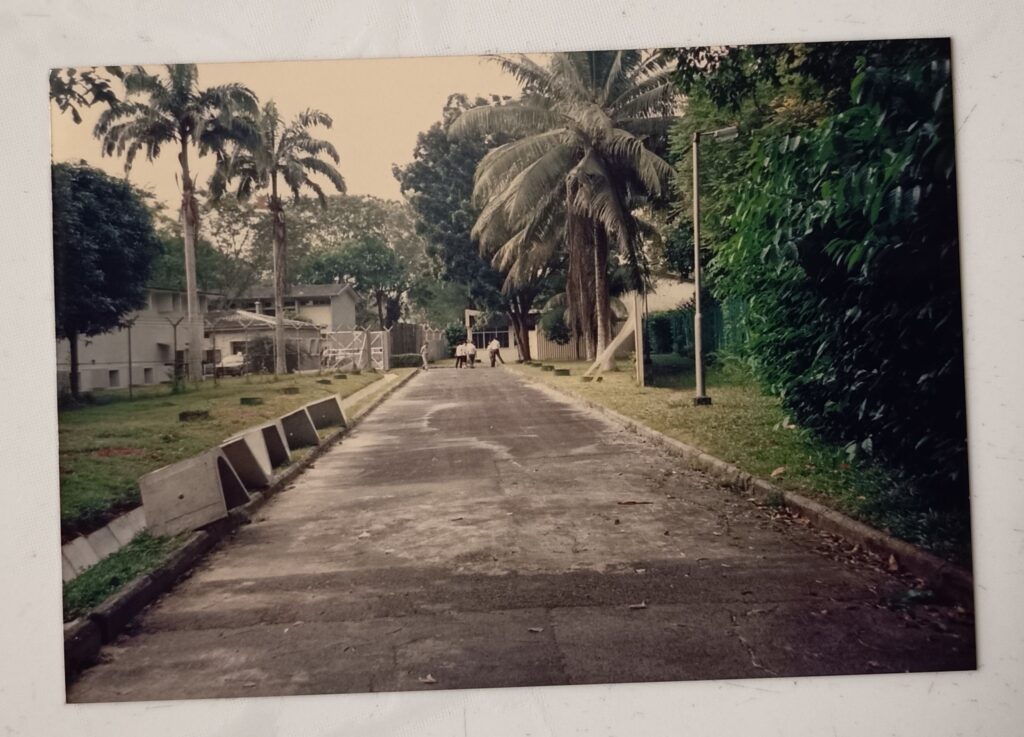
The victims of Lee were tortured and imprisoned for decades without trial. Goh Chok Tong naively or deliberately thinks that the PAP were kind to them. It is their way of silencing their conscience.
Successive PAP leaders use the ISA against those who who tried in some ways to help the poor or unfortunate people to reclaim their rights and dignity. Many were not even political opponents. Victims of Operation Spectrum in 1987 represent the clearest example of how the PAP under its leader, Lee Kuan Yew and his successor, Goh Chok Tong continue to abuse their power by using the ISA to nip community leaders in the bud. They imagine that these leaders would one day enter politics and detain and torture them without trial.
Thursday, 21st May will be the 39th anniversary of Operation Spectrum. The survivors of Operation Spectrum and their friends will remember that on that day, 39 years ago, the ISA was suddenly used against 16 innocent people who never thought they would be the targets of the ruling PAP government.They were rudely woken up at dawn. Plain clothes police officers climbed over gates, banged hard on their doors demanding access to their homes. They ransacked everything including breaking down my door because they expected to find subversive documents and weapons. They found none. Despite that, all of them were detained and many subjected to sleep deprivation and ill treatment.
Part 2
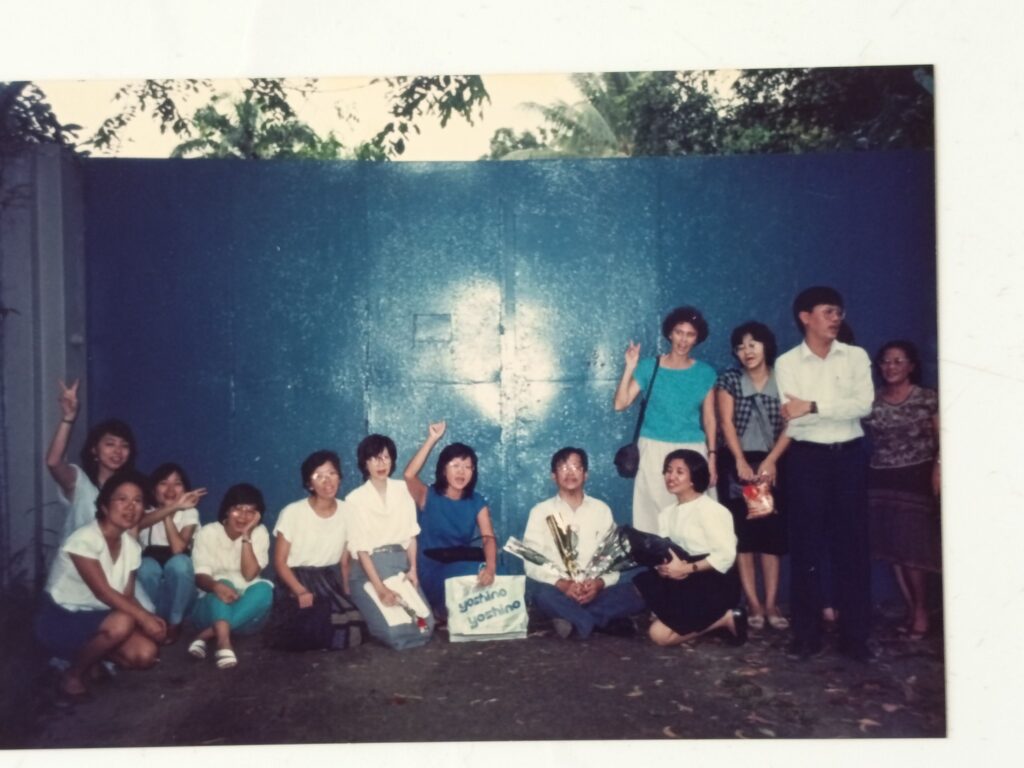
On 21 May 1987, ISD officers refused my request to call the owner of the house to open a locked room. They karate kicked down my door with a loud shattering noise, disturbing all my neighbours that early dawn.
No subversive documents or weapons were found in the room or any of the homes of the 16 people who were arrested and detained that day. Upon my release a few months later, I asked the ISD to pay for the cost of the broken door. They paid.
Just about a month before 21 May 1987, First Deputy Prime Minister Goh Chok Tong was briefed by the ISD about a small group of Muslims who were alleged to be planning riots in Singapore to coincide with the anniversary of the political race riots that took place on May 13, 1969 in Malaysia. Goh explained in TALL ORDER, THE GOH CHOK TONG STORY, (pp 198-200) that at that time, he had to decide whether the group of four Muslims, apparently trained in martial arts should be arrested under the ISA. He asked ISD officers if there was any evidence of weapons for use in the planned riots. The officers assured him that there was none, but they were confident that a cache of weapons would be found. Goh gave the order to arrest.
On 24 April 1987, the group was arrested and detained. Five parangs, two keris and a sword were found in the home of one of those arrested.
As the men were not tried in open court, we do not know if the weapons were genuinely found in the home of one of those arrested. We do not know if the keris and sword were simply decorative pieces displayed on walls.
I don’t want to quibble about whether weapons were actually found in the home of one detainee. What I want to ask Mr Goh today is why he detained 16 people without demanding the production of evidence of weapons or subversive documents. Should he not immediately order the release of all 16 innocent people from detention and compensate them for wrongful arrests, false imprisonment and injuries suffered at the hands of ISD officers?
Part 3
In TALL ORDER THE GOH CHOK TONG STORY, Goh told his interviewers/author about the difficulties in making judgements based on intelligence. He affirmed the correctness of his and Lee Kuan Yew’s decision to arrest 16 alleged Marxists. At page 208 he said:
“Lee, my colleagues and I took the right decision. You will never know the full facts until later. They might be just do-gooders, but when you suspect them of engaging in questionable activities and being manipulated, you do not know where it would lead to. So, if you do not stop such activities and the problem worsens, it becomes too late. And the point we are making is that whatever mission you have, if it is above board, there is no problem. Take us on openly – that is not an issue. Your mission to help the foreign maids, to help the disposessed – that was entirely right. But do not do it in such a secretive, subversive way. The right thing to do was what Teo Soh Lung did years later – she stood for election in 2011.”
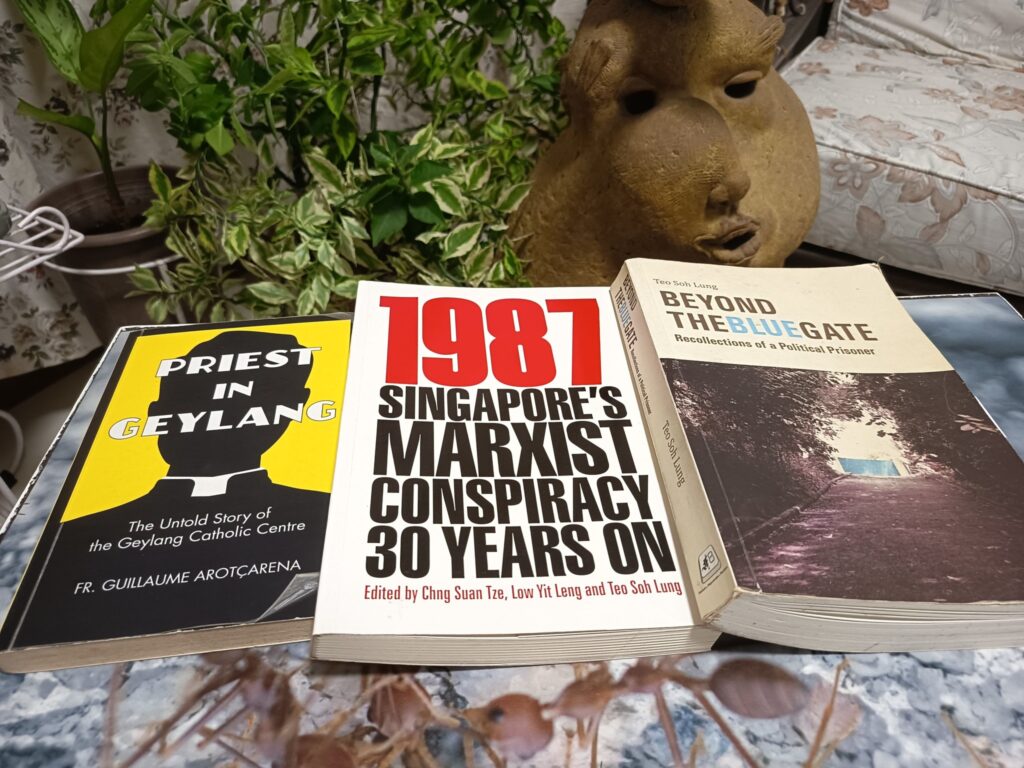
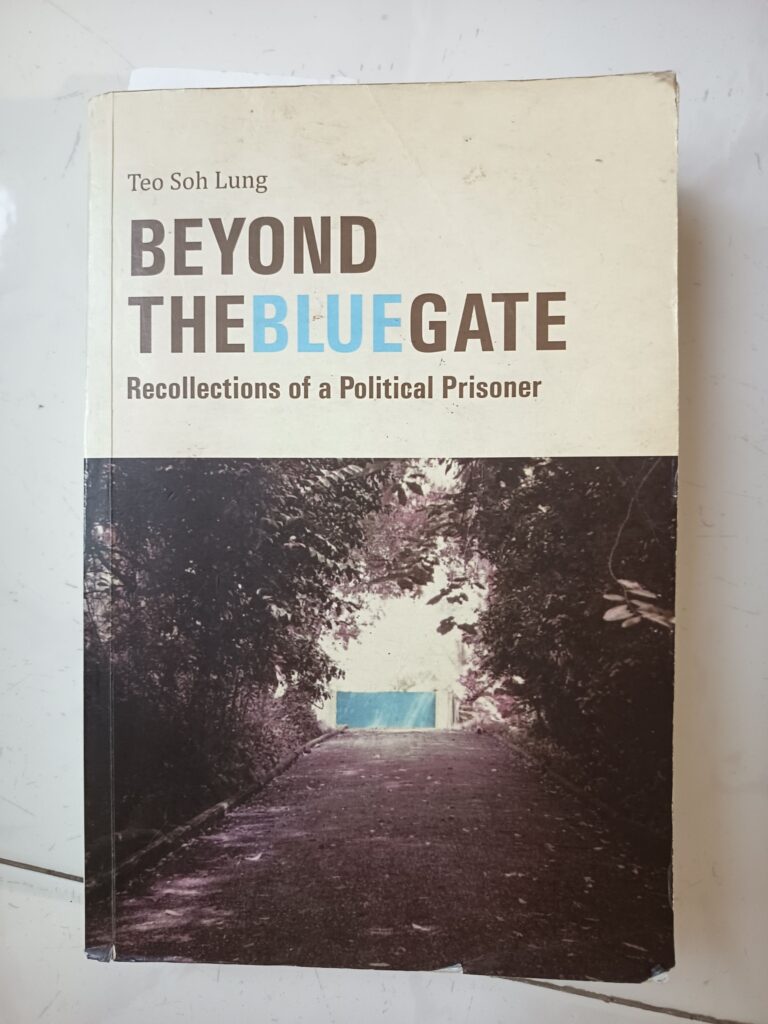
I don’t know if the interviewers/writer raised any questions on Goh’s conclusion that the so called “Marxists” were involved in secret subversive activities. I don’t know if they or Goh had read my book BEYOND THE BLUE GATE published eight years before their book was published or 1987 Singapore’s Marxist Conspiracy. Did they and Goh read PRIEST IN GEYLANG by Fr Guillaume Arotcarena, the founder of the Geylang Catholic Centre?
The Geylang Catholic Centre was an organisation set up with the blessings of the Catholic Church. It assisted foreign workers and provided after care for prisoners, regardless of race, language or religion. In carrying out his work, Fr Arotcarena communicated with the Ministry of Labour and the Immigration Department. How can Goh conclude that the Geylang Catholic Centre was involved in clandestine activities when Fr Arotcarena had openly dealt with these government ministries?
Vincent Cheng who initially worked as a full time staff at the centre later worked for the Justice and Peace Commission. The Commission is an official pastoral body of the Catholic Church dedicated to promoting human dignity, social justice, human rights, and peace. How did Goh reach the conclusion that the 16 arrested were involved in subversive activities when both these organisations were lawfully set up by the Catholic Church? So was the Young Christian Workers headed by the Late Fr Joseph Ho.
In my book, BEYOND THE BLUE GATE, I listed all my activities in the Law Society, Geylang Catholic Centre and the Workers’ Party in my Representation to the Advisory Board. Goh should know that I was questioned by Lee Kuan Yew in the Parliamentary Select Committee a few months before my arrest regarding my small contributions to the Workers’ Party. The Workers’ Party is a legal opposition party. How can participating in activities of the Workers’ Party be regarded as “questionable activities”?
Tall Order is not an autobiography. It is also not a biography or a collection of interviews. It is a mix of all three. I am disappointed that the writer and interviewers did not take the opportunity to ask Goh how he reached his conclusion that innocent citizens doing “good deeds” were involved in secretive subversive activities when the organisations they volunteered with were legal organisations set up by the Catholic Church.
I hope that Goh Chok Tong who now has plenty of free time will read the publications of Function 8.
Not long before my arrest on 21 May 1987, Tan Jing Quee* came to my office specifically to warn me to be careful. I told him: “Jing Quee everything I do is in the open. I have nothing to hide. Why should they arrest me?”
Jing Quee’s response was swift: “Everything we did was also in the open but they arrested us!” I was shocked. But soon I forgot his warning. Jing Quee was right. Everything we did was “above board”. Why were we arrested and imprisoned under the ISA?
Jing Quee is dead. Maybe I have a few more years to go. Give me a response Mr Goh before we end our journey on earth.
*Jing Quee, a lawyer, poet and historian was arrested in 1963 and 1977. He spent more than three years in prison without trial. He was tortured. He died in 2011.
Part 4
Not satisfied with wrecking the lives of 16 people and their families on 21 May 1987, another six people were arrested and detained on 20 June 1987. Two of the six were leaders of the Singapore Polytechnic Students Union. They had issued a press statement denying that the union was under the influence of two of the 16 detained.
How can the government arrest them for rebutting its false allegations? If that was not a blatant abuse of the ISA, then what is?
The third person arrested was a national serviceman. And the remaining three were friends of the 16. They spoke to journalists about the mass arrests. That was their only “crime”. And that was another blatant abuse of the ISA.
It was wicked of PAP leaders to arrest the six persons on the grounds that they were threats to national security. Like the 16, none of the six was found to be in possession of weapons or subversive documents. The arrests were carried out purely to instill fear in the people. “Kill the chicken to teach the monkey”.
When I was a young lawyer, G Raman, my employer told me that Lee Kuan Yew ruled by fear. I didn’t believe him. Years later, I realised that he was right. Singaporeans have internalised fear. It seemed natural for them to avoid speaking up against anything the government does. Or they will automatically look around if they want to say anything that may be slightly critical of the government.
We have lost our freedom of speech without even realising it. Years later, Lee himself admitted that he preferred to rule by fear. Machiavelli had inspired and guided him throughout his life. And he had successfully taught his successors that that was the only way to retain power.
In his interview, Goh Chok Tong claimed that he, Lee Kuan Yew and his son were “honest people in charge”. At page 213 of TALL ORDER THE GOH CHOK TONG STORY, Goh asked:
” … do you allow the fear to therefore do away with the ISA and have more fear after that? That you do not even know what happened, subversively – which is a greater fear? I know we have honest people in charge. Lee Kuan Yew, myself, Lee Hsien Loong. How did the arests in 1987 advance our political purposes? We lost ground in the 1988 general election because people who were unhappy thought we were wrong, that we were overreacting in hauling in some ‘innocent people’, ‘do-gooders’. But if we had abused the act, we would have been out.”
The PAP suffered a small drop of 1.2% of the overall votes from the previous election in 1984. What Goh omitted to say was that Francis Seow, my lawyer who was arrested under the ISA when he came to visit me at the Whitley Detention Centre for my habeas corpus proceedings won 49.1% of the votes in the Eunos GRC. He would have won had it not been for a last minute shift of PAP candidates. But that was part of the political game.
Goh and Lee were shocked at the wins of the Workers Party. They should have graciously accepted their losses and welcomed Francis Seow and Dr Lee Siew Choh as non- constituency members of parliament under their own scheme. But the Machiavelli in them refused to allow them to be gracious. They hounded Francis Seow out of Singapore and forced him to lose his country of birth and die in exile.
Goh consoled himself that the PAP was not voted out in 1988 because it did not abuse the ISA. I am amazed at his conclusion. At the same time, I am flattered that he had thought that the arrest and detention of 22 insignificant people could cost the PAP to lose power. After decades of living in fear, was it realistic for the people to vote the PAP out because of 22 people? The fear of a Machiavelli believer is beyond my imagination.
There is no limit to how vile a politician guided by the ghost of Machiavelli will go. This sad episode will forever be a stain on Singapore’s history and Lee’s final term in office.
Leave a Reply