
by Teo Soh Lung
A government that holds 78 out of 79 seats in parliament can still be afraid of losing power. This is the sorry state of the PAP the 1980s and even today.
Perpetually afraid of more opposition members entering parliament, it adopted the policy of NIP IN THE BUD since the days of its founder, Lee Kuan Yew.
In 1987, the PAP took drastic measures to ensure that at least two Singaporeans living thousands of miles away from Singapore do not return to contest the general election which must be held before the end of 1988.
Holding super majority in parliament, it was easy for the PAP to amend laws and even the most sacred of laws, the Constitution of the Republic of Singapore. Thus in 1985, the PAP presented a bill to amend Article 135 of the Constitution. Any citizen (including a citizen by birth) who has not returned to Singapore for a continuous period of 10 years may be deprived of his Singapore citizenship.
Tan Wah Piow was one such citizen. He had proven himself to be a thorn in the flesh of the government when he was a young architecture student in the 1970s. They tried to get rid of him by fabricating a riot in the Pioneer Industries Employees’ Union in Jurong. He was charged for rioting and duly convicted by the First District Judge, Mr T S Sinnathuray. He served a jail term and left Singapore, escaping enlistment into the army. Since then he has been living as an exile in London.
In 1984 or 1985, Tan Wah Piow had intended to return home to Singapore. He was prepared to pay the usual fine and jail term for evading national service. He made enquiries from personnel who he thought could assist him. But before he could complete his preparations to return, the PAP government pre-empted him from returning. He received a notification that the government would deprive him of his citizenship because he had failed to return home for 10 years.
Tan Wah Piow appointed me as his lawyer He instructed me to oppose the decision of the government. How could it deprive a citizen by birth of his citizenship? It was against international law! But even before I could take my client’s full instructions, I together with 15 others were arrested under the Internal Security Act on 21 May 1987. Tan Wah Piow was named the alleged leader of the “Marxist Conspirators”. His entire file was taken away when security officers raided my office.
Making sure that Tan Wah Piow would not be able to return to Singapore was not sufficient for a vindictive government. Even arresting another six innocent young people a month later, on 20 June 1987 was not enough. In July that year, the Controller of Immigration issued a notification to Paul Lim Huat Chye, a PhD student at the Catholic University of Louvain in Belgium, cancelling his Singapore passport with immediate effect. It promised to issue a document of identity to enable him to return if he was aggrieved by the decision. The letter read:
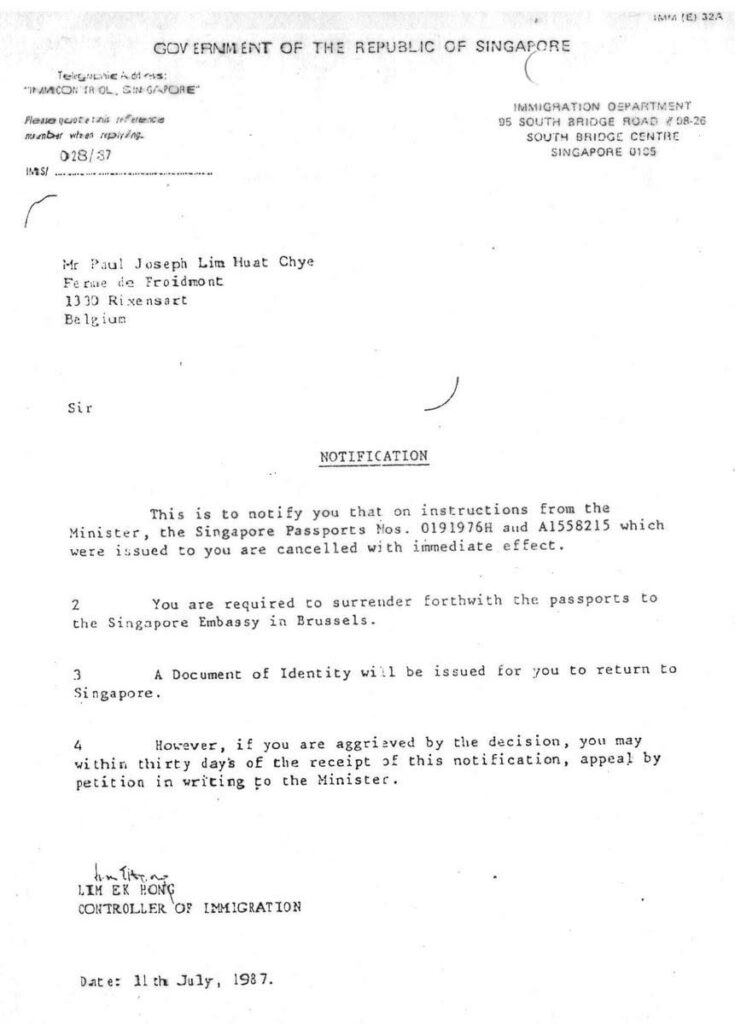
Sir
NOTIFICATION
This is to notify you that on instructions from the Minister, the Singapore Passport Nos. 0191976H and A1558215 which were issued to you are cancelled with immediate effect.
2 You are required to surrender forthwith the passports to the Singapore Embassy in Brussels.
3 A Document of Identity will be issued for you to return to Singapore.
4 However, if you are aggrieved by the decision, you may within thirty days of the receipt of this notification, appeal by petition in writing to the Minister.
SdLIM EK HONGCONTROLLER OF IMMIGRATION
Date: 11th July, 1987
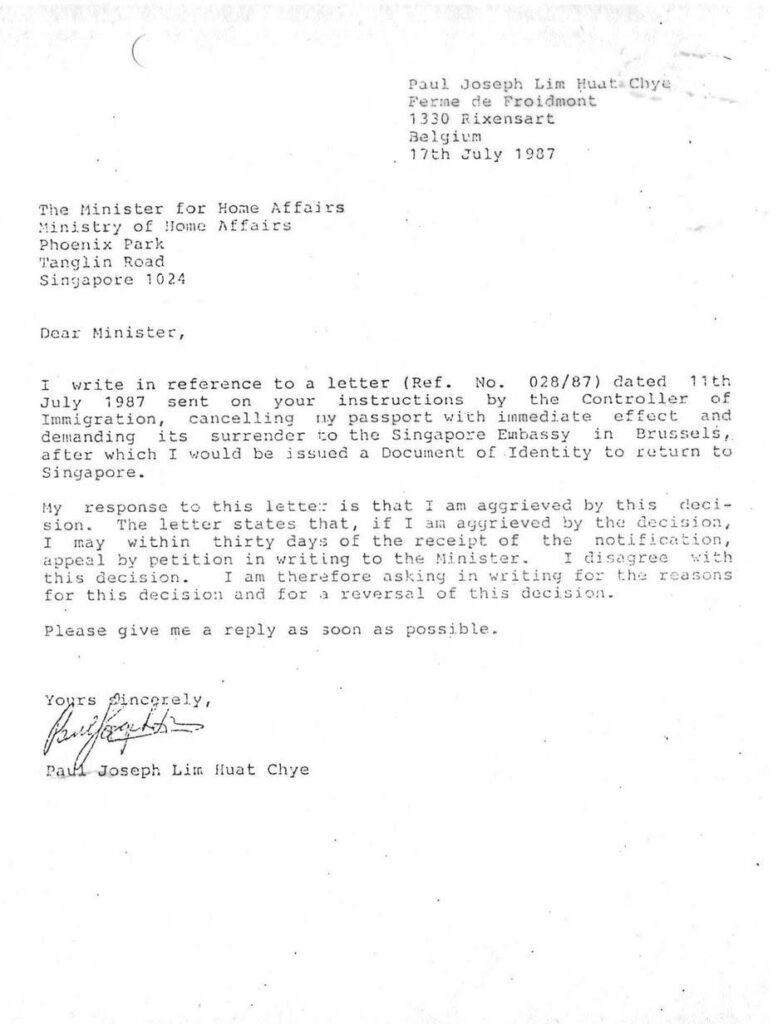
It was an invitation to Paul Lim to deliver himself into the lion’s den and be eaten up like the 22 already in detained. Paul Lim asked for the government’s reasons for cancelling his passport. As expected, the government kept silent. A warrant of arrest was also issued against him. Paul was thus compelled to issue a press statement on 18 July 1987. It reads as follows:
“Statement by Paul Lim concerning Minister’s decision to cancel his passport.
On 15th July 1987 I received by registered post a Notification (copy attached below) dated 11 July 1987 from the Singapore Embassy in Brussels in which I was informed that my Singapore passport was cancelled forthwith.
In my reply (copy attached below) I have asked for a written explanation of this decision. However, it is fair to suppose that this decision is connected with the fact that the Singapore government has issued an arrest warrant in my name under the Internal Security Act which permits detention without trial. This notification is clearly an attempt to compel me to return to Singapore and place myself in the hands of the Internal Security Department.
I ask again that I be removed from this wanted list. My political activities in Singapore have never in any way been illegal or illegitimate. If one removes the terms “Marxist conspiracy”, from the Singapore government’s accusations against me, I am only ‘accused of activities which are in reality – and under Singapore law – perfectly legal and acceptable. Talking politics to friends is legitimate and lawful. Describing my political activities and those of others as conspiratorial is no more than an unsubstantiated allegation. The only ‘evidence’ offered by the Singapore government is that provided by confessions of those recently detained – confessions obtained in conditions of “continuous interrogation under extreme psychological pressure” according to Amnesty International.
The PAP government has no right to cancel my passport for my legitimate and legal political activities. “Marxist conspiracy” and “Marxist conspirators” are simply pretexts to destroy nascent sources of a credible alternative opposition – something which the PAP itself claims to wish for.
SdPaul LimFerme de Froidmont1330 RixensartBelgique18th July 1987″
Despite what the PAP government did, Paul Lim continued to contribute to the well being of Singapore. He co-founded the European Institute of Asian Studies (EIAS) in 1989 (see https://eias.org/news/in-memoriam-paul-joseph-lim/ ) and entertained Singapore diplomats when they arrived in Brussels. But as Paul’s friend, I know that he was deeply hurt by what the Singapore government had done to him in 1987. He visited Singapore once at the invitation of a university or organisation and stayed with the Belgium ambassador who was also his guarantor. Thereafter, he never returned. He worked at his institute in Penang for several years. Friends would meet up with him when he was in the region.
He died in Belgium on 21 July 2025
Leave a Reply