Part 1 of 6: Post War and Fajar
Part 2 of 6: Merdeka Years
Part 3 of 6: PAP In Power
Part 4 of 6: Barisan Sosialis
Part 5 of 6: Operation Coldstore
Part 6 of 6: Last Years of Detention

Part 1 of 6: Post War and Fajar
Part 2 of 6: Merdeka Years
Part 3 of 6: PAP In Power
Part 4 of 6: Barisan Sosialis
Part 5 of 6: Operation Coldstore
Part 6 of 6: Last Years of Detention
by Teo Soh Lung
Reading the Ministry of Home Affairs’ press release of 24 June 2026 is depressing. In March 2026, Tarmizi bin Mohd Taha (30) was issued with an Order for Detention (OD) and Cyrus Dzulqarnain Al-Shariar (19) was released on a Restriction Order (RO). Cyrus was probably detained for investigation for about 30 days as permitted by the Internal Security Act (ISA). Both orders did not specify the duration. Under the ISA, detention and restriction orders are for indefinite duration. The ministry has finally realised that it is pointless to state the duration of these orders.
It is my observation that whenever there is unrest, wars or new organised movements in other parts of the world, the Singapore government is quick to use the ISA against its opponents or people who have different opinions from them. The arrests are made on the pretext that citizens need to be protected from impending terrorist attacks.
It started with the arrests of alleged communists from the 1960s to the 1970s. Then the euro-communists in the 1970s and the Marxists in the 1980s. In the 1990s, I wondered who would be the next victims. Fortunately for the following 20 years, no one was arrested. Chia Thye Poh who was arrested in 1966 was released in 1989. He was subjected to severe restrictions for another 9 years. Vincent Cheng was released in 1990. So for 20 years, there were no ISA prisoners.
In 2001, the World Trade Centre was destroyed. Al-Qaeda was blamed for carrying out the aeroplane attacks. At least 38 Muslims in Singapore were arrested and detained under the ISA in 2001 and 2002 accused of being members of Al-Qaeda regional group, Jemaah Islamiyah (JI). See https://function8.sg/?s=detainees+list . I am not sure if three of those detainees are still in detention.
Who destroyed the World Trade Centre? The Americans like to believe that it was Osama bin Laden and his group who did it. They killed him but was he the culprit? Why didn’t they try him in America? Till today, rumours are still circulating that the attacks were not carried out by Al-Qaeda or Osama bin Laden but by Israel.
The government’s press releases concerning ISA arrests since 2001 are always the same. The usual allegations are made – that they were inspired by groups far away and were influenced by social media and chat groups; they were self-radicalised and their families were not aware of what they were doing; they wanted to join the resistant movement in Syria but have no financial means to travel there; they wanted to destroy the world order and were anti Zionists, anti LGBT and anti-women. In the most recent press release, Tarmizi was alleged to have communicated with a foreign contact “who claimed to be a HAMAS member”. Cyrus was pro Hamas and viewed them as defenders of the Palestinians.
Bearing in mind that those detained do not even know of the existence of such press releases, the government is free to say what it wants. So we have to read all these press releases with open minds. Don’t trust the reports in The Straits Times. They do not do or are not permitted to do investigative journalism.
I find the government’s allegations against the detainees baseless. To continue to detain Tarmizi over his views on the Israeli-Palestinian conflict is ludicrous. When it claimed that he and Cyrus’ “radicalisation were triggered by the ongoing Israeli-Palestinian conflict”, what do they mean? What is wrong with Tarmizi becoming “deeply interested in the Israeli-Palestinian conflict following HAMAS’ October 7, 2023 attacks against Israel? Lots of people become aware of the decades old conflict only after October 7.
It is time for our government to stop using the ISA as a tool to control the minds of people who are interested in what is happening outside Singapore. Singaporeans should not be ignorant of what is happening in other parts of the world or as the Malays nicely put it, we should not be “Katak di-bawah tempurung” (frogs under the shell). It is easy to arrest and detain people on the words of the minister. For detainees, it is pointless to seek fairness and justice from our courts as various habeas corpus applications have shown. The government should think of the families of the detainees who may have been deprived of their sole bread winners.
by Teo Soh Lung
A government that holds 78 out of 79 seats in parliament can still be afraid of losing power. This is the sorry state of the PAP the 1980s and even today.
Perpetually afraid of more opposition members entering parliament, it adopted the policy of NIP IN THE BUD since the days of its founder, Lee Kuan Yew.
In 1987, the PAP took drastic measures to ensure that at least two Singaporeans living thousands of miles away from Singapore do not return to contest the general election which must be held before the end of 1988.
Holding super majority in parliament, it was easy for the PAP to amend laws and even the most sacred of laws, the Constitution of the Republic of Singapore. Thus in 1985, the PAP presented a bill to amend Article 135 of the Constitution. Any citizen (including a citizen by birth) who has not returned to Singapore for a continuous period of 10 years may be deprived of his Singapore citizenship.
Tan Wah Piow was one such citizen. He had proven himself to be a thorn in the flesh of the government when he was a young architecture student in the 1970s. They tried to get rid of him by fabricating a riot in the Pioneer Industries Employees’ Union in Jurong. He was charged for rioting and duly convicted by the First District Judge, Mr T S Sinnathuray. He served a jail term and left Singapore, escaping enlistment into the army. Since then he has been living as an exile in London.
In 1984 or 1985, Tan Wah Piow had intended to return home to Singapore. He was prepared to pay the usual fine and jail term for evading national service. He made enquiries from personnel who he thought could assist him. But before he could complete his preparations to return, the PAP government pre-empted him from returning. He received a notification that the government would deprive him of his citizenship because he had failed to return home for 10 years.
Tan Wah Piow appointed me as his lawyer He instructed me to oppose the decision of the government. How could it deprive a citizen by birth of his citizenship? It was against international law! But even before I could take my client’s full instructions, I together with 15 others were arrested under the Internal Security Act on 21 May 1987. Tan Wah Piow was named the alleged leader of the “Marxist Conspirators”. His entire file was taken away when security officers raided my office.
Making sure that Tan Wah Piow would not be able to return to Singapore was not sufficient for a vindictive government. Even arresting another six innocent young people a month later, on 20 June 1987 was not enough. In July that year, the Controller of Immigration issued a notification to Paul Lim Huat Chye, a PhD student at the Catholic University of Louvain in Belgium, cancelling his Singapore passport with immediate effect. It promised to issue a document of identity to enable him to return if he was aggrieved by the decision. The letter read:
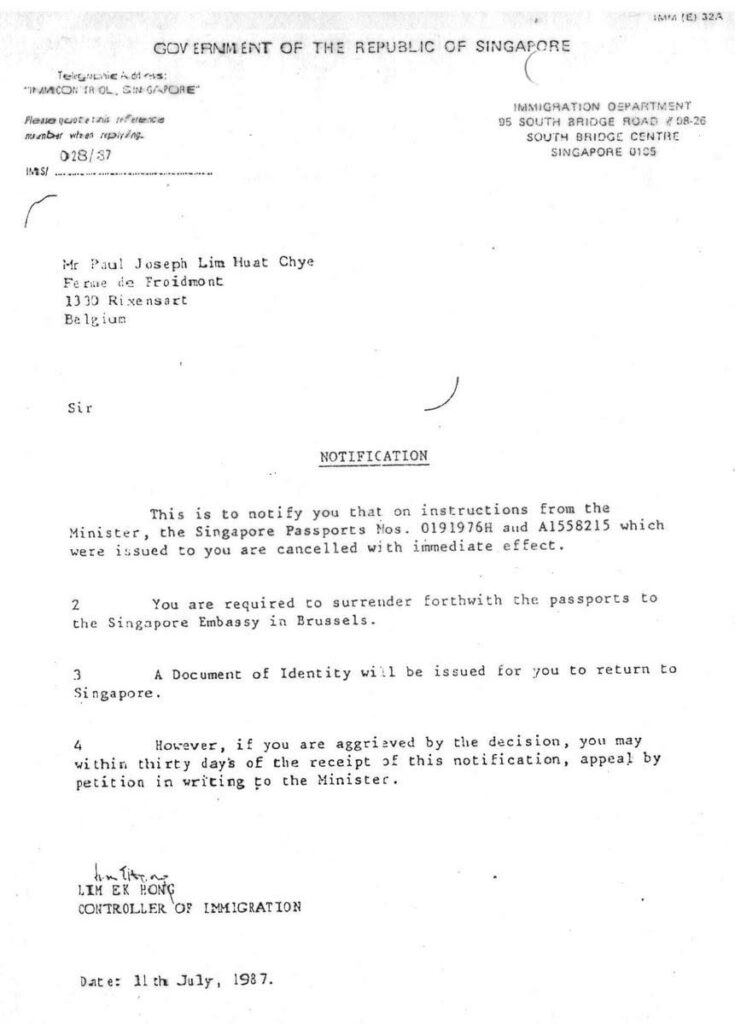
Sir
NOTIFICATION
This is to notify you that on instructions from the Minister, the Singapore Passport Nos. 0191976H and A1558215 which were issued to you are cancelled with immediate effect.
2 You are required to surrender forthwith the passports to the Singapore Embassy in Brussels.
3 A Document of Identity will be issued for you to return to Singapore.
4 However, if you are aggrieved by the decision, you may within thirty days of the receipt of this notification, appeal by petition in writing to the Minister.
SdLIM EK HONGCONTROLLER OF IMMIGRATION
Date: 11th July, 1987
It was an invitation to Paul Lim to deliver himself into the lion’s den and be eaten up like the 22 already in detained. Paul Lim asked for the government’s reasons for cancelling his passport. As expected, the government kept silent. A warrant of arrest was also issued against him. Paul was thus compelled to issue a press statement on 18 July 1987. It reads as follows:
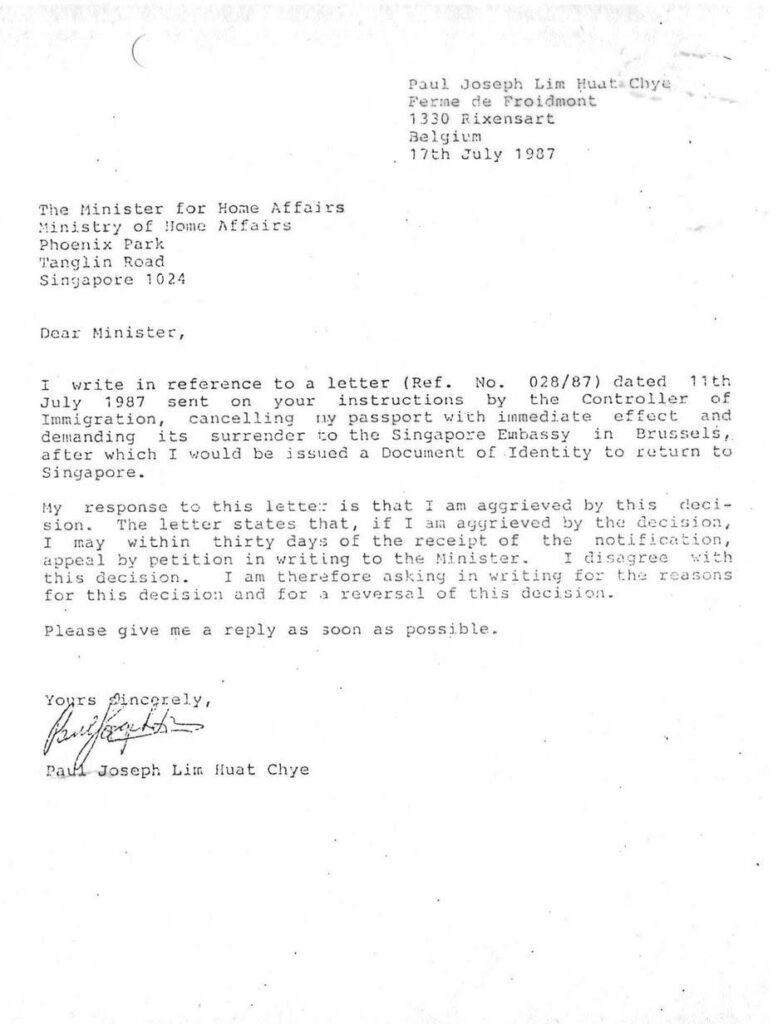
“Statement by Paul Lim concerning Minister’s decision to cancel his passport.
On 15th July 1987 I received by registered post a Notification (copy attached below) dated 11 July 1987 from the Singapore Embassy in Brussels in which I was informed that my Singapore passport was cancelled forthwith.
In my reply (copy attached below) I have asked for a written explanation of this decision. However, it is fair to suppose that this decision is connected with the fact that the Singapore government has issued an arrest warrant in my name under the Internal Security Act which permits detention without trial. This notification is clearly an attempt to compel me to return to Singapore and place myself in the hands of the Internal Security Department.
I ask again that I be removed from this wanted list. My political activities in Singapore have never in any way been illegal or illegitimate. If one removes the terms “Marxist conspiracy”, from the Singapore government’s accusations against me, I am only ‘accused of activities which are in reality – and under Singapore law – perfectly legal and acceptable. Talking politics to friends is legitimate and lawful. Describing my political activities and those of others as conspiratorial is no more than an unsubstantiated allegation. The only ‘evidence’ offered by the Singapore government is that provided by confessions of those recently detained – confessions obtained in conditions of “continuous interrogation under extreme psychological pressure” according to Amnesty International.
The PAP government has no right to cancel my passport for my legitimate and legal political activities. “Marxist conspiracy” and “Marxist conspirators” are simply pretexts to destroy nascent sources of a credible alternative opposition – something which the PAP itself claims to wish for.
SdPaul LimFerme de Froidmont1330 RixensartBelgique18th July 1987″
Despite what the PAP government did, Paul Lim continued to contribute to the well being of Singapore. He co-founded the European Institute of Asian Studies (EIAS) in 1989 (see https://eias.org/news/in-memoriam-paul-joseph-lim/ ) and entertained Singapore diplomats when they arrived in Brussels. But as Paul’s friend, I know that he was deeply hurt by what the Singapore government had done to him in 1987. He visited Singapore once at the invitation of a university or organisation and stayed with the Belgium ambassador who was also his guarantor. Thereafter, he never returned. He worked at his institute in Penang for several years. Friends would meet up with him when he was in the region.
He died in Belgium on 21 July 2025
by Teo Soh Lung
On 21 May 1987, sixteen people were arrested and detained under the ISA. Paul Lim Huat Chye who resides in Belgium was named by the Singapore government as part of the marxist conspiracy to overthrow the PAP government using violent means. It was an false and absurd allegation against an innocent man who at that time was trying to finish his PhD thesis at the Louvain Catholic University. That allegation not only interrupted the completion of his thesis, it also led him to lose his Singapore citizenship.
Below is Paul Lim’s refutation of the Singapore government’s false allegation against him:
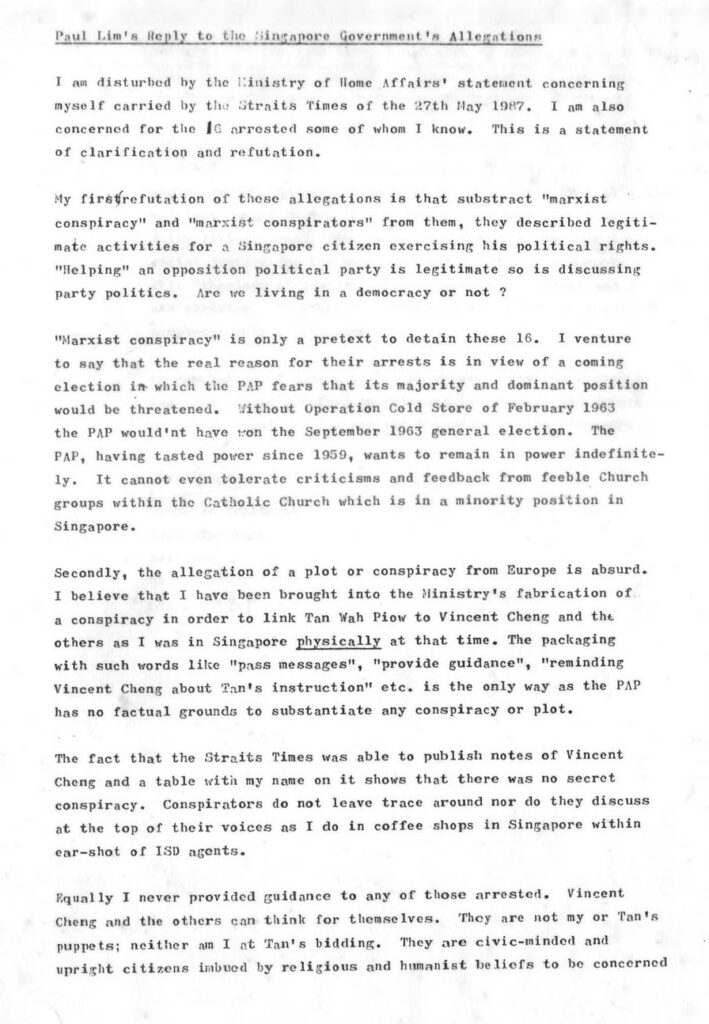
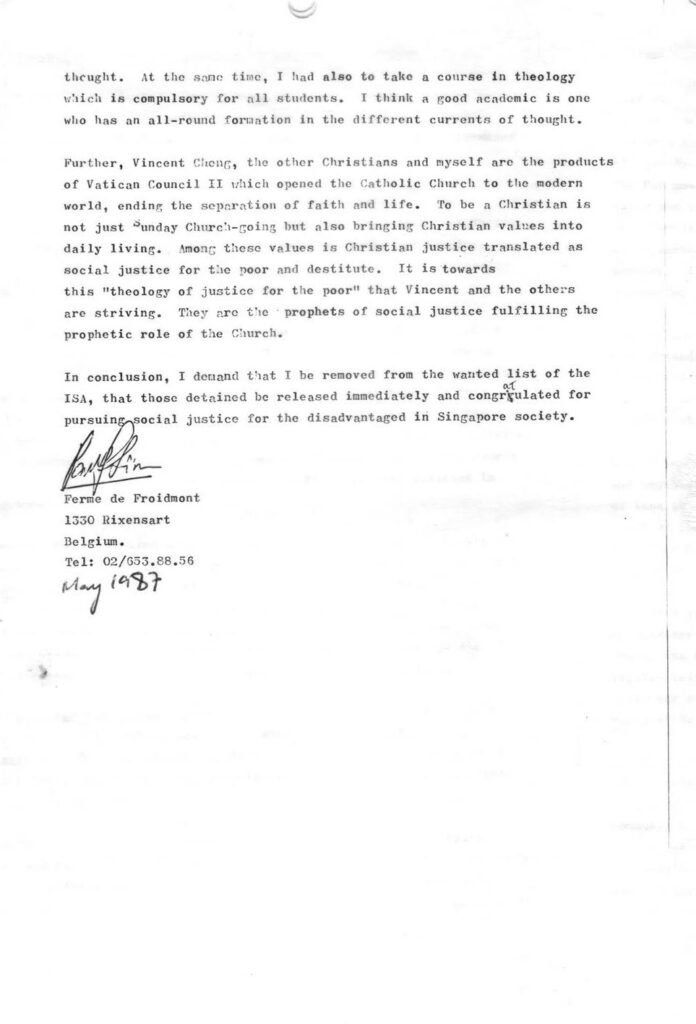
Paul Lim’s Reply to the Singapore government’s Allegations
I am disturbed by the Ministry of Home Affairs’ statement concerning myself carried by the Straits Times of the 27th May 1987. I am also concerned for the 16 arrested some of whom I know. This is a statement of clarification and refutation.
My first refutation of these allegations is that subtract “marxist conspiracy” and “marxist conspirators” from them, they described legitimate activities for a Singapore citizen exercising his political rights. “Helping” an opposition political party is legitimate, so is discussing party politics. Are we living in a democracy or not?
“Marxist conspiracy” is only a pretext to detain these 16. I venture to say that the real reason for their arrests is in view of a coming election in which the PAP fears that its majority and dominant position would be threatened. Without Operation Cold Store of February 1963 the PAP would’nt have won the September 1963 general election. The PAP, having tasted power since 1959, wants to remain in power indefinitely. It cannot even tolerate criticisms and feedback from feeble Church groups within the Catholic Church which is in a minority position in Singapore.
Secondly, the allegation of a plot or conspiracy from Europe is absurd. I believe that I have been brought into the Ministry’s fabrication of a conspiracy in order to link Tan Wah Piow to Vincent Cheng and the others as I was in Singapore physically at that time. The packaging with such words like “pass messages”, “Provide guidance”, “reminding Vincent Cheng about Tan’s instruction” etc is the only way as the PAP has no factual grounds to substantiate any conspiracy or plot.
The fact that the Straits Times was able to publish notes of Vincent Cheng and a table with my name on it shows that there was no secret conspiracy. Conspirators do not leave trace around nor do they discuss at the top of their voices as I do in coffee shops in Singapore within ear-shot of ISD agents.
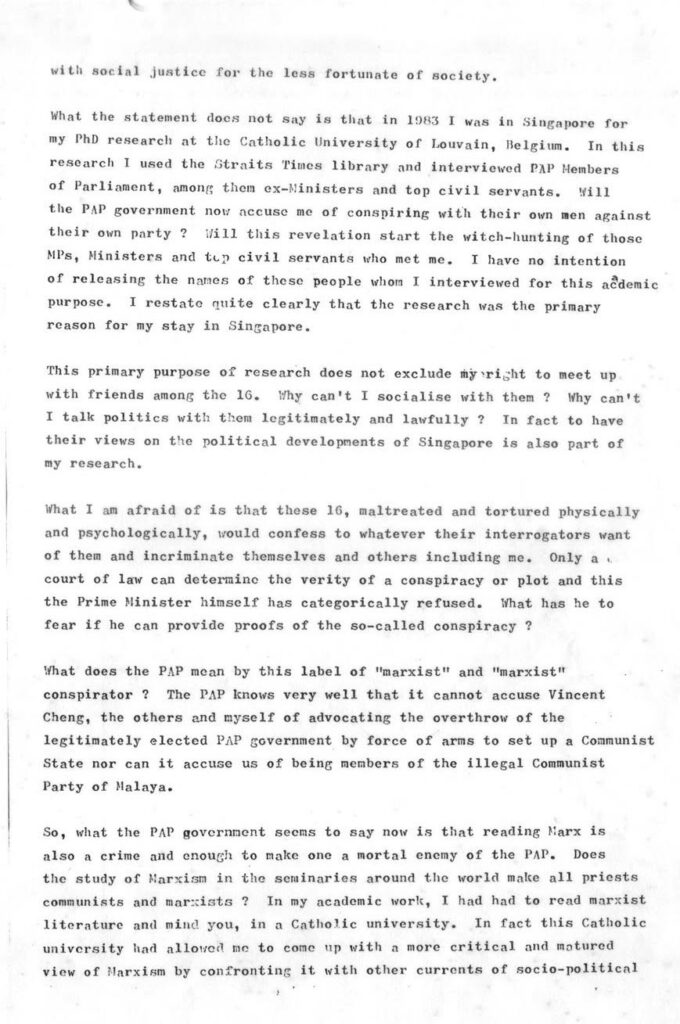
Finally I never provided guidance to any of those arrested. Vincent Cheng and the others can think for themselves. They are not my or Tan’s puppets: neither am I at Tan’s bidding. They are civic-minded and upright citizens imbued by religious and humanist beliefs to be concerned with social justice for the less fortunate of society.
What the statement does not say is that in 1983 I was in Singapore for my PhD research at the Catholic University of Louvain, Belgium. In this research I used the Straits Times library and interviewed PAP Members of Parliament, among them ex-Ministers and top civil servants. Will the PAP government now accuse me of conspiring with their own men against their own party? Will this revelation start the witch-hunting of those MPs, Ministers and top civil servants who met me? I have no intention of releasing the names of those people whom I interviewed for this academic purpose. I restate quite clearly that the research was the primary reason for my stay in Singapore.
This primary purpose of research does not exclude my right to meet up with friends among the 16. Why can’t I socialise with them? Why can’t I talk politics with them legitimately and lawfully? In fact to have their views on the political developments of Singapore is also part of my research.
What I am afraid of is that these 16, maltreated and tortured physically and psychologically, would confess to whatever their interrogators want of them and incriminate themselves and others including me. Only a court of law can determine the verity of a conspiracy or plot and this the Prime Minister himself has categorically refused. What has he to fear if he can provide proofs of the so-called conspiracy?
What does the PAP mean by this label of “Marxist” and “Marxist conspirator? The PAP knows very well that it cannot accuse Vincent Cheng, the others and myself of advocating the overthrow of the legitimately elected PAP government by force of arms to set up a Communist State nor can it accuse me of being members of the illegal Communist Party of Malaya.
So, what the PAP seems to say now is that reading Marx is also a crime and enough to make one a mortal enemy of the PAP. Does the study of Marxism in the seminaries around the world make all priests communists and Marxists? In my academic work, I had had to read Marxist literature and mind you, in a Catholic university. In fact this Catholic university had allowed me to come up with a more critical and matured view of Marxism by confronting it with other currents of socio-political thought. At the same time, I had also to take a course in theology which is compulsory for all students. I think a good academic is one who has all -round formation in different currents of thought.
Further, Vincent Cheng, the other Christians and myself are the products of Vatican II which opened the Catholic Church to the modern world, ending the separation of faith and life. To be a Christian is not just Sunday Church going but also bringing Christian values into daily living. Among these values is Christian justice translated as social justice for the poor and destitute. It is towards this “theology of justice for the poor” that Vincent and the others are striving. They are the prophets of social justice fulfilling the prophetic role of the Church.
In conclusion, I demand that I be removed from the wanted list of the ISA, that those detained be released immediately and congratulated for pursuing social justice for the disadvantaged in Singapore society.
SignedPaul LimFerme de Froidmont1330 Rixensart
List of Reports and Briefs:
A Report on the Detentions in Singapore, May and June 1987: A Statement of Facts, Emergency Committee for Human Rights in Singapore, (NZ), June 21, 1987
Report of the International Mission of Jurists to Singapore, International Commission of Jurists (Geneva), International Federation of Human Rights (Paris), Asian Human Rights Commission (Hong Kong), July 1987.
Briefing Document for the Visit to Singapore by Asia Watch, Washington DC, (NZ: ECHRIS) 23 October, 1987
Press Briefing for World Methodist Conference, Singapore, July 1991, (NZ: ECHRIS)
On 21 May, 1987, sixteen young Singaporean professionals and their families were shocked to be woken from their sleep in the early hours of the morning by Singapore’s secret police from the Internal Security Department hammering on their doors and breaking in. They were then dragged to underground cells where they would be detained for many days of round-the-clock interrogation including physical and psychological abuse without access to lawyers or families. And then the secret police came for more young Singaporeans…
The reaction of the international community was an outpouring of support for the detainees that was immediate, spontaneous and global. This took the Singapore government by surprise and it paid a high political price internationally for its brazen disregard of human rights. The claim that there was a Marxist conspiracy in Singapore was simply unbelievable to most international observers. That period was long gone.
But, within Singapore, it did achieve its goal of frightening a new generation of socially-committed Singaporeans into political submission so that the PAP could more easily transition to its own new generation of leadership without facing an emerging electoral challenge. The cost to those targeted so unjustly was severe, affecting the rest of their lives.
This saga was documented by various organisations. The Emergency Committee for Human Rights in Singapore, based in New Zealand, began sending out news releases which became regular Updates sought after by international organisations, embassies, parliamentarians and NGOs around the world, many of which launched their own formal enquiries and protests. The Updates comprise the main content of these archives and provide a public record of events as they unfolded.
For the first time, these records enable everyone to gain detailed knowledge of this dark stain on Singapore’s political history.
Update 1
Update 2
Update 3
Update 4
Update 5
Update 6
Update 7
Update 8
Update 9
Update 10
Update 11
Update 12
Update 13
Update 14
Update 15
Update 16
Update 17
Update 18
Update 19
Update 20
Update 21
Update 22
Update 23
Update 24
Update 25
Update 26
Update 27
Update 28