Month: June 2026


  • Paul Lim Huat Chye

    by Teo Soh Lung

    On 21 May 1987, sixteen people were arrested and detained under the ISA. Paul Lim Huat Chye who resides in Belgium was named by the Singapore government as part of the marxist conspiracy to overthrow the PAP government using violent means. It was an false and absurd allegation against an innocent man who at that time was trying to finish his PhD thesis at the Louvain Catholic University. That allegation not only interrupted the completion of his thesis, it also led him to lose his Singapore citizenship.

    Below is Paul Lim’s refutation of the Singapore government’s false allegation against him:
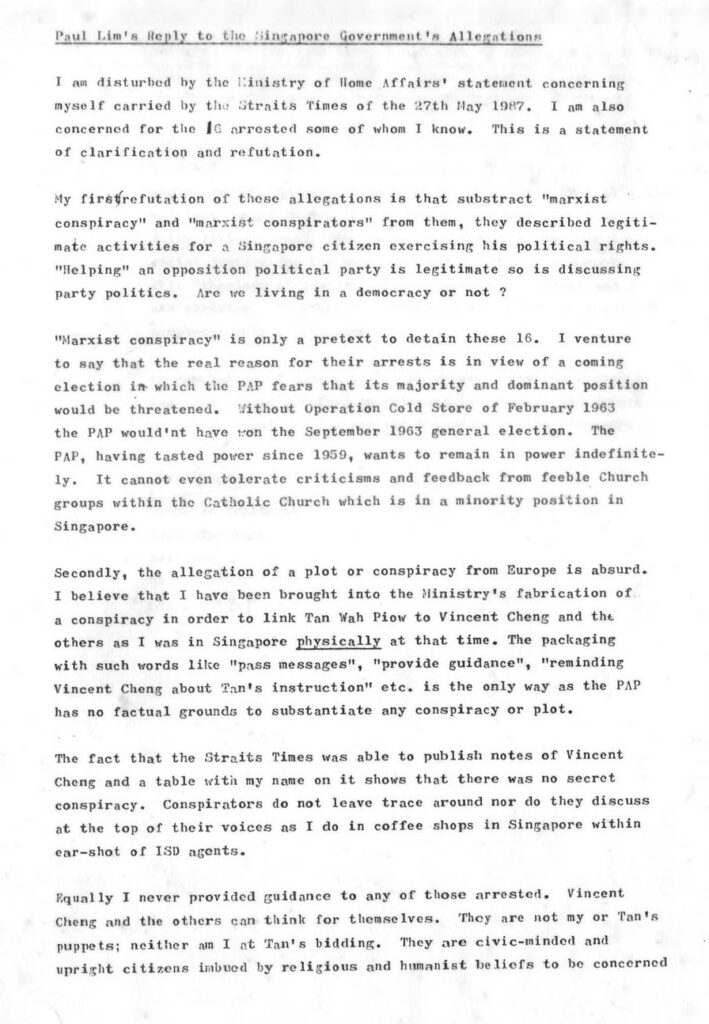
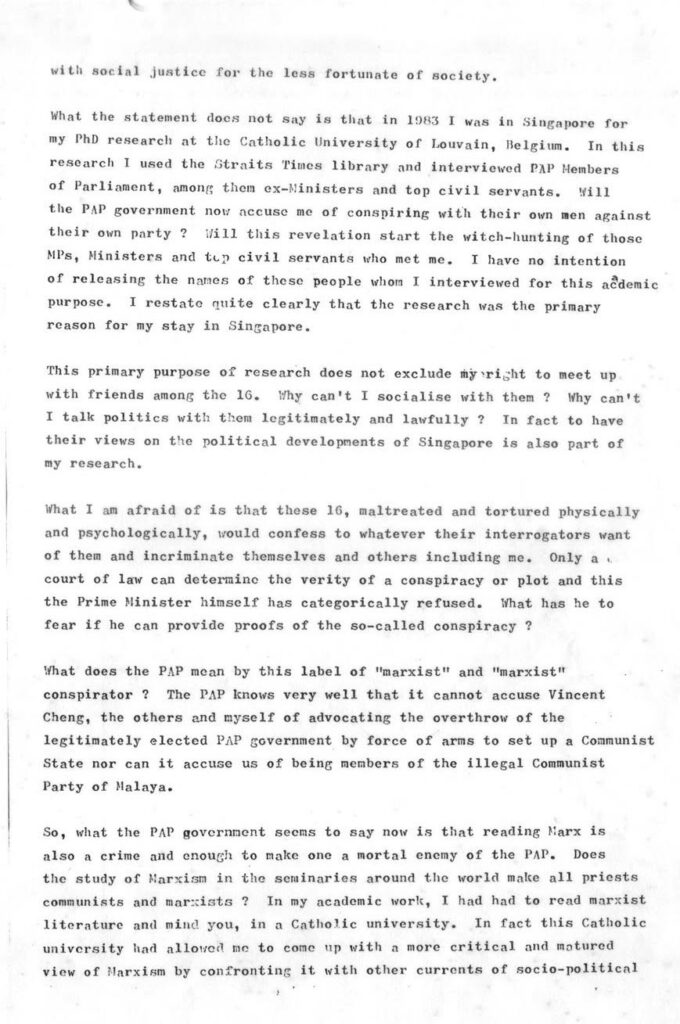
    Paul Lim’s Reply to the Singapore government’s Allegations

    I am disturbed by the Ministry of Home Affairs’ statement concerning myself carried by the Straits Times of the 27th May 1987. I am also concerned for the 16 arrested some of whom I know. This is a statement of clarification and refutation.

    My first refutation of these allegations is that subtract “marxist conspiracy” and “marxist conspirators” from them, they described legitimate activities for a Singapore citizen exercising his political rights. “Helping” an opposition political party is legitimate, so is discussing party politics. Are we living in a democracy or not?

    “Marxist conspiracy” is only a pretext to detain these 16. I venture to say that the real reason for their arrests is in view of a coming election in which the PAP fears that its majority and dominant position would be threatened. Without Operation Cold Store of February 1963 the PAP would’nt have won the September 1963 general election. The PAP, having tasted power since 1959, wants to remain in power indefinitely. It cannot even tolerate criticisms and feedback from feeble Church groups within the Catholic Church which is in a minority position in Singapore.

    Secondly, the allegation of a plot or conspiracy from Europe is absurd. I believe that I have been brought into the Ministry’s fabrication of a conspiracy in order to link Tan Wah Piow to Vincent Cheng and the others as I was in Singapore physically at that time. The packaging with such words like “pass messages”, “Provide guidance”, “reminding Vincent Cheng about Tan’s instruction” etc is the only way as the PAP has no factual grounds to substantiate any conspiracy or plot.

    The fact that the Straits Times was able to publish notes of Vincent Cheng and a table with my name on it shows that there was no secret conspiracy. Conspirators do not leave trace around nor do they discuss at the top of their voices as I do in coffee shops in Singapore within ear-shot of ISD agents.

    Finally I never provided guidance to any of those arrested. Vincent Cheng and the others can think for themselves. They are not my or Tan’s puppets: neither am I at Tan’s bidding. They are civic-minded and upright citizens imbued by religious and humanist beliefs to be concerned with social justice for the less fortunate of society.

    What the statement does not say is that in 1983 I was in Singapore for my PhD research at the Catholic University of Louvain, Belgium. In this research I used the Straits Times library and interviewed PAP Members of Parliament, among them ex-Ministers and top civil servants. Will the PAP government now accuse me of conspiring with their own men against their own party? Will this revelation start the witch-hunting of those MPs, Ministers and top civil servants who met me? I have no intention of releasing the names of those people whom I interviewed for this academic purpose. I restate quite clearly that the research was the primary reason for my stay in Singapore.

    This primary purpose of research does not exclude my right to meet up with friends among the 16. Why can’t I socialise with them? Why can’t I talk politics with them legitimately and lawfully? In fact to have their views on the political developments of Singapore is also part of my research.

    What I am afraid of is that these 16, maltreated and tortured physically and psychologically, would confess to whatever their interrogators want of them and incriminate themselves and others including me. Only a court of law can determine the verity of a conspiracy or plot and this the Prime Minister himself has categorically refused. What has he to fear if he can provide proofs of the so-called conspiracy?

    What does the PAP mean by this label of “Marxist” and “Marxist conspirator? The PAP knows very well that it cannot accuse Vincent Cheng, the others and myself of advocating the overthrow of the legitimately elected PAP government by force of arms to set up a Communist State nor can it accuse me of being members of the illegal Communist Party of Malaya.

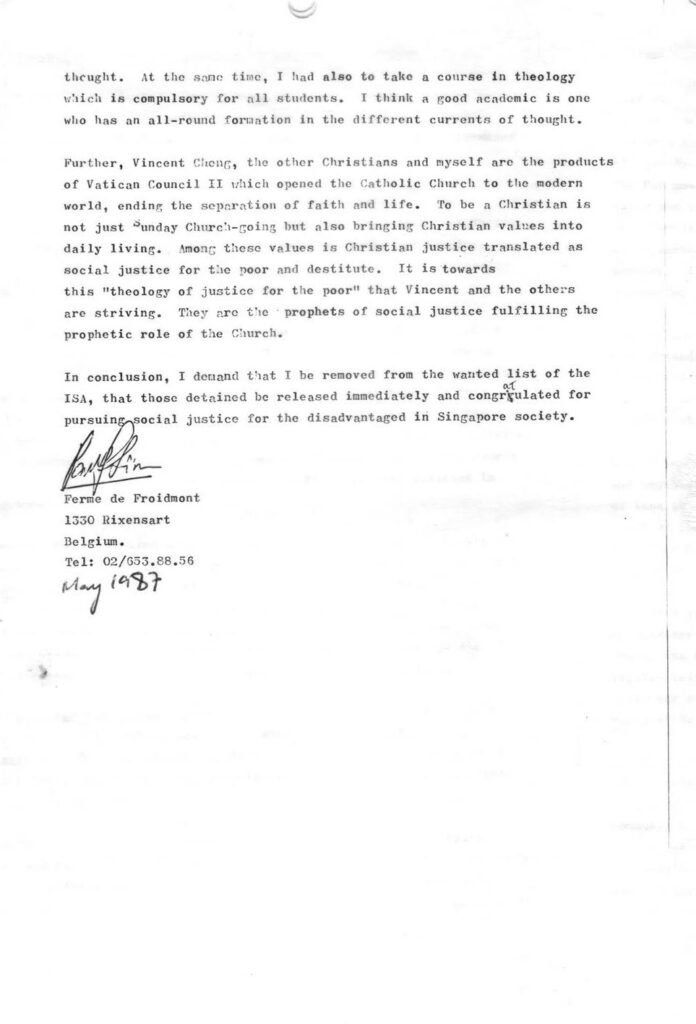
    So, what the PAP seems to say now is that reading Marx is also a crime and enough to make one a mortal enemy of the PAP. Does the study of Marxism in the seminaries around the world make all priests communists and Marxists? In my academic work, I had had to read Marxist literature and mind you, in a Catholic university. In fact this Catholic university had allowed me to come up with a more critical and matured view of Marxism by confronting it with other currents of socio-political thought. At the same time, I had also to take a course in theology which is compulsory for all students. I think a good academic is one who has all -round formation in different currents of thought.

    Further, Vincent Cheng, the other Christians and myself are the products of Vatican II which opened the Catholic Church to the modern world, ending the separation of faith and life. To be a Christian is not just Sunday Church going but also bringing Christian values into daily living. Among these values is Christian justice translated as social justice for the poor and destitute. It is towards this “theology of justice for the poor” that Vincent and the others are striving. They are the prophets of social justice fulfilling the prophetic role of the Church.

    In conclusion, I demand that I be removed from the wanted list of the ISA, that those detained be released immediately and congratulated for pursuing social justice for the disadvantaged in Singapore society.

    Signed
    Paul Lim
    Ferme de Froidmont
    1330 Rixensart
    Tel: 02|653.88.56
    May 1987

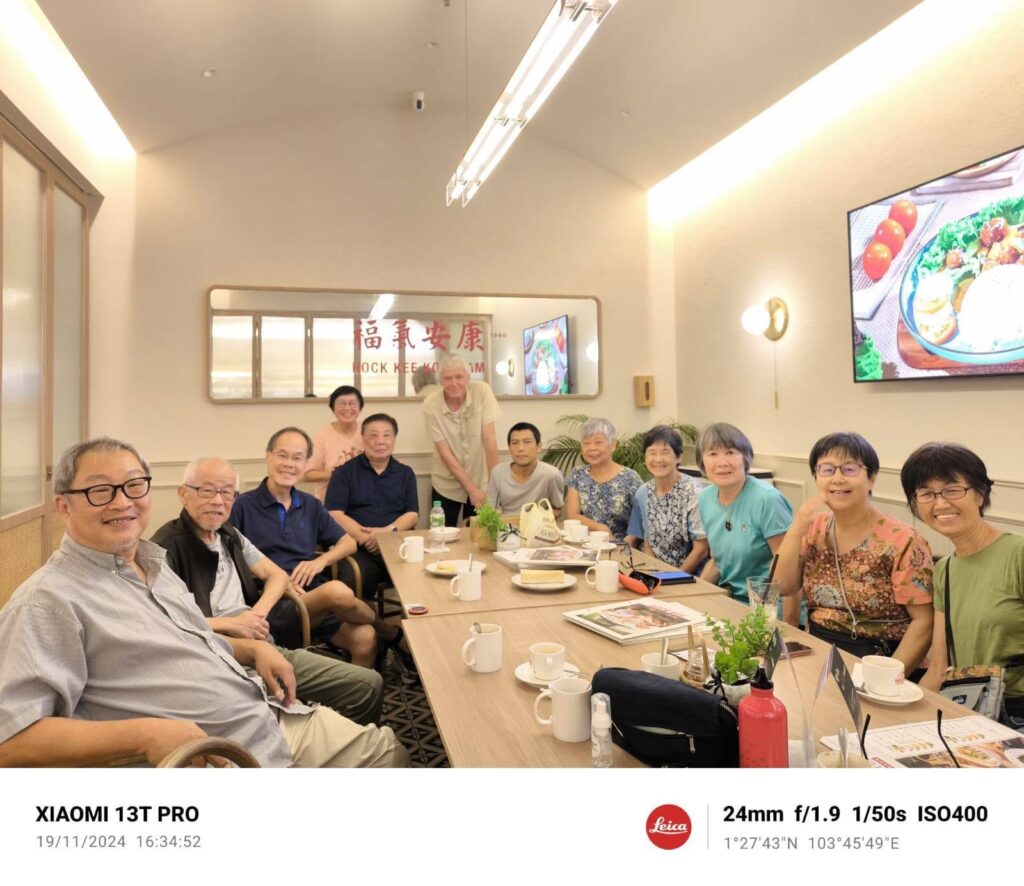
    Paul Lim with Singapore friends in JB. It was his last visit to Malaysia.


  • Harassment Of The Catholic Church

    by Teo Soh Lung

    Thirty-nine years ago today, six young Singaporeans were arrested under the Internal Security Act (ISA). An earlier arrest of 16 people on 21 May 1987 failed to satisfy the PAP regime. The six arrested were Chew Kheng Chuan, Chng Suan Tze, Tang Fong Har, Fan Wan Peng, Ronnie Ng and Noor Affandi Shahid. 

    The first three were friends of several of those earlier arrested and detained while the remaining three were Singapore Polytechnic students. Their “crime” was simply to issue a statement denying the government’s allegation that some of those who were arrested had anything to do with their activism in the polytechnic. Like the 16, none of the six was found to have weapons or documents showing that they had been involved or intended to cause any upheaval in Singapore using violent or non violent means. 

    It is interesting to learn from Singapore Human Right Alert which Function 8 had recently upload on their website, that soon after arresting the 16 people on 21 May 1987, the PAP government faced a barrage of protests from all over the world. Ministers and diplomats were kept busy by foreign journalists. They were surprised that the detainees had so many friends outside Singapore who were willing to spend time campaigning for their release. Several had even delayed their pursuits in higher academic qualifications. PM Lee Kuan Yew and his ministers were shocked and angry. What was worse was that the Catholic Church in Singapore appeared to be supportive of the detainees. On 27 May, Archbishop Gregory Yong had presided over a mass at the Church of Our Lady of Perpetual Succour which was attended by 2500 people. Many had to stand outside the church. Four family members of those detained gave personal testimonies. A press statement was issued and a pastoral letter was read in all Catholic Churches on Sunday, 31 May.

    PM Lee was angry and likely worried that the Singapore Catholic Church would follow the Churches in the Philippines and South Korea in protesting against their corrupt governments. He had to tame the Church, to nip it in the bud. He had subdued the foreign press and political opponents before. The Catholic Church should not pose any difficulty especially when his minions like Dr Ee Peng Liang, a lay Catholic holding some influential position in the Church would obey his orders. 

    So a plan was hatched. A meeting would be arranged with Archbishop Yong and his representatives who must be approved by PM Lee and the ISD. Following that meeting, the strategy was to shock the archbishop with the appearance of the the Vatican Charge d’Affairs, Fr Giovanni D’Aniello and appear at a press conference with local journalists. 

    The Archbishop and his representatives were thus invited to the Istana. They were given selected written statements of Vincent Cheng to read. PM Lee then met with them. After the meeting, they left the Istana for the carpark. But before the archbishop could drive off, he was called back to the Istana to meet a “European priest”. Not suspecting any foul play, the archbishop told his representatives to drive off. 

    Returning to the Istana alone, he met the European priest, Vatican Charge d’Affairs, Fr Giovanni D’Aniello who had flown in from Bangkok. How he was snatched from the Singapore airport and whisked off to the Istana to meet the prime minister and the archbishop, no one knows. It cannot be coincidental because PM Lee was a master strategist. He liked to use the shock and awe technique to extract maximum results in his favour. 

    At the Istana, the archbishop was apparently advised by Fr Giovanni who had met and discussed with PM Lee earlier to make a statement based on what the government had told him. (I wouldn’t be surprised if that was PM Lee’s idea!). 

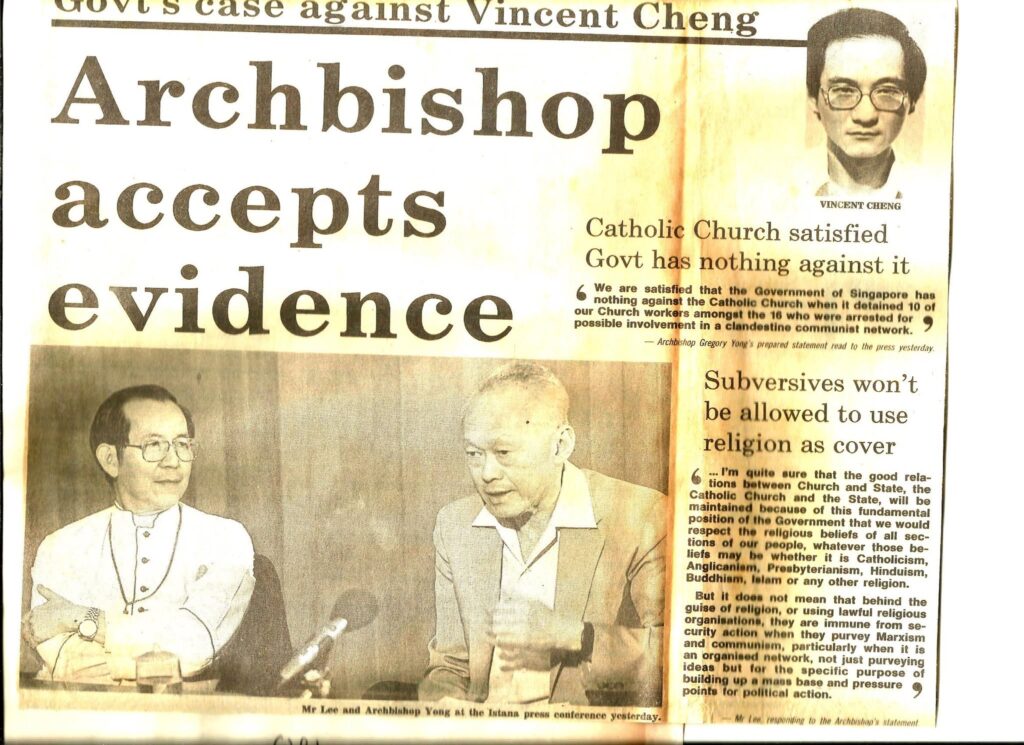
    And so a press conference was convened. Only local journalists were present. Foreign journalists were not invited. The archbishop then declared that he had to accept the government’s evidence that Vincent Cheng had made use of the Church because he himself had admitted it. Clearly, the archbishop being a religious person could not appreciate that a person in custody and tortured was not capable of writing any truthful statement.

    ARCHBISHOP ACCEPTS GOVT “EVIDENCE” 

    Human Rights Alert Update No. 4 of 3 June 1987 reported the surprise press conference of 2 June 1987 as follows: 

    “Archbishop Turns the Key. Detainees’ Families Harrassed. “

    Giving in to constant pressure from the government Archbishop Gregory Yong yesterday joined Prime Minister Lee Kuan Yew in a press conference from which the foreign press was excluded. The Archbishop said he was shown the government’s files on Vincent Cheng and was satisfied with the evidence because “…the man himself admitted that he was using the church…”. However, the Archbishop has not yet talked to Vincent Cheng himself.”

    How could the archbishop abandon his flock on 2 June when just a week ago, on 27 May he had presided over a mass at the Church of Our Lady of Perpetual Succour attended by 2500 people? How could he forget that his Church had issued a press statement supporting the 16 detainees the following day and a pastoral letter was read in all churches on Sunday, 31 May?

    After the act of disowning his flock at the press conference, it was easy for the Archbishop to simply obey the orders of Lee and his minions. While churches in Australia, New Zealand, Japan, South Korea, Europe, England and America openly supported the detainees and prayed for their release, the archbishop continued to listen to the orders of the PAP government. The four priests, Joseph Ho, Patrick Goh, Guiliaume Arotcarena and Edgar D’Souza tendered immediate resignations from their positions in the organisations they presided in order to avoid a conflict between church and state. The threat of arrests was real at that time if they did not resign. A few days later on 6 June, the archbishop without any notice, suspended them from preaching and having any contact with the organisations they were working with. Fr Arotcarena in his book PRIEST IN GEYLANG said that he learnt about his suspension from The Straits Times. Churches were forbidden to openly pray for the detainees. It was so absurd for the head of a powerful Catholic Church to act in the way he did. Till today, I cannot accept or understand why he had behaved in such a disgraceful, cowardly manner.

    Since the archbishop had refused to help the detainees, the families of Catholic detainees wrote to the Pope. Below is the report from Update No. 7:

    LETTER TO POPE 

    The families have expressed their sense of abandonment by the Catholic Church after the Archbishop of Singapore, Gregory Yong, gave his support to the Government and prohibited prayers for the detainees from being said in his parish churches. He has further instructed the families that they should not attend the same church together. 

    In a letter to Pope John Paul II expressing their grief and sense of injustice, the families say, “Holy Father, every moment, every heartbeat, we are praying that God will protect His servants who have been detained… But it is difficult to be strong, for we feel like sheep whose shepherd has left them and we do not know which way to turn.”

    The archbishop had abandoned his flock. What he did was not only wrong but foolish. If he thought that Lee would respect him for that, he was naive. 

    Anyway, the archbishop is dead. In my opinion, he was no comparison to his predecessor Archbishop Michel Olçomendy MEP who I respect for his firm stand against the PAP’s “Stop at Two” policy.


  • 1987 Operation Spectrum (Reports & Briefs)

    List of Reports and Briefs:

    • A Report on the Detentions in Singapore, May and June 1987: A Statement of Facts, Emergency Committee for Human Rights in Singapore, (NZ), June 21, 1987
    • Report of the International Mission of Jurists to Singapore, International Commission of Jurists (Geneva), International Federation of Human Rights (Paris), Asian Human Rights Commission (Hong Kong), July 1987.
    • Briefing Document for the Visit to Singapore by Asia Watch, Washington DC, (NZ: ECHRIS) 23 October, 1987
    • Press Briefing for World Methodist Conference, Singapore, July 1991, (NZ: ECHRIS)

    A Report on the Detentions in Singapore, May and June 1987: A Statement of Facts, Emergency Committee for Human Rights in Singapore, (NZ), June 21, 1987

    Report of the International Mission of Jurists to Singapore, International Commission of Jurists (Geneva), International Federation of Human Rights (Paris), Asian Human Rights Commission (Hong Kong), July 1987.

    Briefing Document for the Visit to Singapore by Asia Watch, Washington DC, (NZ: ECHRIS) 23 October, 1987

    Press Briefing for World Methodist Conference, Singapore, July 1991, (NZ: ECHRIS)


  • The Mass Arrest of Young Singaporean Professionals in 1987

    On 21 May, 1987, sixteen young Singaporean professionals and their families were shocked to be woken from their sleep in the early hours of the morning by Singapore’s secret police from the Internal Security Department hammering on their doors and breaking in. They were then dragged to underground cells where they would be detained for many days of round-the-clock interrogation including physical and psychological abuse without access to lawyers or families. And then the secret police came for more young Singaporeans…

    The reaction of the international community was an outpouring of support for the detainees that was immediate, spontaneous and global. This took the Singapore government by surprise and it paid a high political price internationally for its brazen disregard of human rights. The claim that there was a Marxist conspiracy in Singapore was simply unbelievable to most international observers. That period was long gone.

    But, within Singapore, it did achieve its goal of frightening a new generation of socially-committed Singaporeans into political submission so that the PAP could more easily transition to its own new generation of leadership without facing an emerging electoral challenge. The cost to those targeted so unjustly was severe, affecting the rest of their lives.

    This saga was documented by various organisations. The Emergency Committee for Human Rights in Singapore, based in New Zealand, began sending out news releases which became regular Updates sought after by international organisations, embassies, parliamentarians and NGOs around the world, many of which launched their own formal enquiries and protests. The Updates comprise the main content of these archives and provide a public record of events as they unfolded.

    For the first time, these records enable everyone to gain detailed knowledge of this dark stain on Singapore’s political history.

    Update 1

    Update 2

    Update 3

    Update 4

    Update 5

    Update 6

    Update 7

    Update 8

    Update 9

    Update 10

    Update 11

    Update 12

    Update 13

    Update 14

    Update 15

    Update 16

    Update 17

    Update 18

    Update 19

    Update 20

    Update 21

    Update 22

    Update 23

    Update 24

    Update 25

    Update 26

    Update 27

    Update 28